The Right Tool for the Right Mind: Rethinking How We Teach
13 min read
Picture two classrooms down the hall from each other.
In the first, students sit in neat rows. The teacher stands at the front, demonstrating how to solve quadratic equations. Step one, step two, step three. Students practice twenty similar problems. Each correct answer earns a checkmark. The rhythm is clear: instruction, practice, feedback, mastery.
In the second classroom, it's controlled chaos. Students cluster around tables, arguing about how to build a water filtration system from household materials. The teacher circulates, asking questions: "What if you tried...?" "How do you know that will work?" There are no checkmarks here. There's barely a right answer.
Here's the paradox: both classrooms might be doing exactly what they should be doing. Or both might be failing their students spectacularly. The difference isn't in the energy level or the furniture arrangement. It's in something far more fundamental—something we've been arguing about for over a century.
The Battle That Shaped Modern Education
For the past hundred years, education has been caught in a quiet war between two radically different visions of how human beings learn. These aren't just academic theories gathering dust in education journals. They're the invisible architecture behind every classroom decision, every curriculum design, every moment a teacher chooses to explain something or step back and let students struggle.
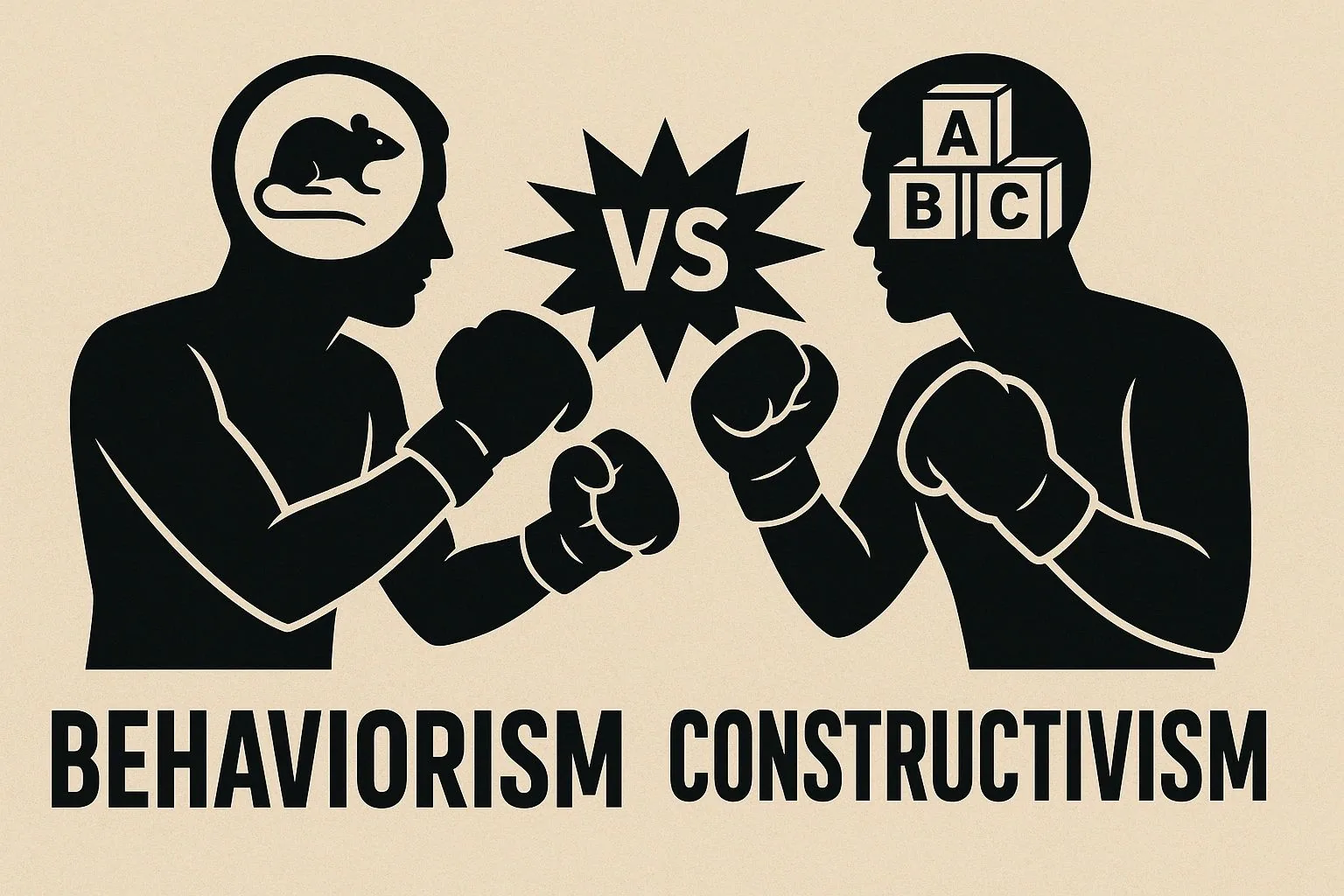
The first vision we call behaviorism. The second, constructivism. And the tension between them has shaped everything from how we teach reading to whether we give grades, from standardized testing to the open classroom movement.
But here's what's fascinating: what if the real question isn't which one is right, but when each one is right?
The Machine That Learns: Behaviorism's Promise
Let's travel back to 1948. B.F. Skinner, a young psychologist, is sitting in his Harvard laboratory with a peculiar contraption—a box containing a rat, a lever, and a food dispenser. He's discovered something remarkable: behavior follows predictable patterns. Press the lever, get food, and the rat learns. Withhold the food, and the behavior disappears. Add the food back randomly, and you create behavior that's almost impossible to extinguish.
Skinner looked at this and saw something revolutionary: What if the human mind works the same way? What if learning is simply a matter of shaping behavior through carefully designed rewards and consequences?
The behaviorists had a bold claim: you don't need to worry about what's happening inside someone's head. The mind is a black box. What matters is observable behavior—what goes in (the stimulus) and what comes out (the response). Everything else is just speculation.
This wasn't just cold mechanism. To Skinner and his followers, this was liberation. If learning is about conditioning, then anyone can learn anything with the right design. There's no mystery, no innate genius required. Just clear objectives, systematic practice, immediate feedback, and appropriate reinforcement.
Think about what this enables. A child struggling with multiplication tables? Break it down into smaller steps. Provide immediate correction when they're wrong, immediate praise when they're right. Use repetition and rewards. Build automaticity through drill and practice. The approach works. I mean, it genuinely works for certain kinds of learning.
In the 1950s and 60s, this philosophy transformed American education. Programmed instruction manuals broke complex skills into tiny, sequential steps. Teaching machines—Skinner's passion project—delivered instant feedback. Behavioral objectives specified exactly what students should be able to do by lesson's end. The classroom became efficient, measurable, scientific.
But here's the question: Can you teach someone to be curious through reinforcement? Can you condition creativity? Can you drill someone into becoming a critical thinker?
The Mind That Builds: Constructivism's Rebellion
While Skinner was watching rats in boxes, a Swiss psychologist named Jean Piaget was watching children play. And he noticed something behaviorism couldn't explain.
A child believes that when you pour water from a short, wide glass into a tall, thin glass, the amount of water changes. You can tell them they're wrong a hundred times. You can reward them for saying the right answer. But they won't truly understand conservation of volume until their cognitive structures are ready—until they've constructed that understanding through their own experience and reflection.
Piaget's insight was radical: learning isn't something that happens to you. It's something you do**.**
Knowledge isn't transmitted from teacher to student like pouring water from one vessel to another. Instead, each learner actively constructs understanding by fitting new experiences into their existing mental models. When new information doesn't fit, there's cognitive conflict—what Piaget called disequilibrium—and that tension drives learning. The learner has to reorganize, rebuild, construct something new.
Lev Vygotsky, working in Soviet Russia in the 1930s, added another dimension: we don't construct knowledge alone. Learning is fundamentally social. Children don't just build understanding in isolation; they construct it through dialogue, through culture, through the zone of proximal development—that sweet spot just beyond what they can do alone but within reach with guidance.
By the 1980s and 90s, constructivism was ascendant in education reform. The teacher's role shifted from sage on the stage to guide on the side. Classrooms became learner-centered. Discovery learning, inquiry-based instruction, project-based learning—these became the watchwords. The goal wasn't to fill students with facts but to help them become active builders of their own understanding.
This philosophy gave us some of education's most powerful tools: collaborative learning, authentic real-world tasks, the recognition that students come to us with prior knowledge that shapes everything they'll learn next.
But here's the uncomfortable question: What about the student who's drowning in open-ended discovery? What about the foundational skills that do require repetition and practice? Can everything be discovered? Should everything be constructed from scratch?
The Productivity Paradox: What Dan Pink Taught Us About Motivation
Now, let me introduce a third character in this story—someone from outside education entirely.
In 2009, writer Dan Pink published a book called Drive that synthesized decades of motivation research. And buried in that book is a key that might unlock our educational dilemma.
Pink distinguished between two types of tasks:
Algorithmic tasks have a clear set of rules and a defined path to solution. Think of a factory assembly line, data entry, or solving a standard math problem using a known procedure. For these tasks, if-then rewards actually work. "If you do X, then you get Y." The promise of a bonus or a gold star can enhance performance.
Heuristic tasks, on the other hand, have no clear path to the solution. They require creativity, insight, problem-solving. Think of designing a marketing campaign, writing a novel, or figuring out how to reduce your company's carbon footprint. Here's the shock: for heuristic tasks, extrinsic rewards often decrease performance. The carrot and stick doesn't just fail to work—it backfires.
Study after study showed the same pattern. Offer people money to solve creative problems, and they actually do worse than people offered no reward. Why? Because external rewards narrow our focus. They make us more efficient at simple tasks, but they shut down the peripheral vision, the playfulness, the cognitive flexibility required for insight.
What Pink identified is that heuristic tasks require intrinsic motivation—autonomy, mastery, and purpose. The desire to direct our own lives, to get better at something that matters, to serve something larger than ourselves.
The Synthesis: A Framework for Strategic Teaching
Now, here's where it gets interesting. What if we mapped Pink's algorithmic-heuristic distinction onto our behaviorism-constructivism debate?
What if the reason we've been arguing for a century about which learning theory is correct is that we've been asking the wrong question? What if the right question is: Which approach for which kind of learning?
Consider this framework:
For algorithmic learning—foundational skills with clear procedures:
- Multiplication facts
- Spelling rules
- Basic computation
- Keyboard typing
- Lab safety protocols
- Musical scales
- Athletic fundamentals
Here, behaviorist approaches make sense. We want automaticity. We want these skills to become so ingrained that they require no conscious thought, freeing up cognitive resources for higher-order thinking. Direct instruction, systematic practice, immediate feedback, even rewards for progress—these work. And Pink's research suggests that for these routine tasks, extrinsic motivation isn't harmful; it can actually help.
For heuristic learning—complex, open-ended challenges:
- Scientific investigation
- Essay composition
- Mathematical problem-solving
- Design thinking
- Ethical reasoning
- Artistic creation
- Strategic planning
Here, constructivist approaches shine. Students need to grapple with ambiguity, construct their own pathways, build deep conceptual understanding. They need autonomy, collaboration, authentic problems. The teacher's role becomes facilitating discovery, asking probing questions, creating cognitive conflict. And extrinsic rewards would likely undermine the intrinsic motivation these tasks require.
Pause for a moment and think about your own learning. When were you taught something through clear instruction and practice, and it worked beautifully? When did you need to struggle through something yourself before it clicked? Can you feel the difference between those two types of learning?
The Complications: Why It's Never That Simple
But before we get too comfortable with this neat framework, let's complicate it. Because the most important insights often live in the complications.
First complication: The line between algorithmic and heuristic isn't as clear as it seems.
Take multiplication. On the surface, it's algorithmic—there are right answers, procedures to follow. But what if, instead of just memorizing times tables, students discover the patterns themselves? What if they notice that 7×8 is the same as 7×7 plus 7, or that multiplication is just repeated addition? Now they're constructing conceptual understanding, not just executing an algorithm. And that deeper understanding might transfer to new mathematical situations in ways that rote memorization never would.
Second complication: What's algorithmic for an expert is heuristic for a novice.
A chess grandmaster's opening moves are automatic—algorithmic. But for a beginner, every opening is a creative problem requiring thought and exploration. A professional writer might have algorithmic processes for editing, but for a student, revision is deeply heuristic. As we develop expertise, we compress complex heuristic processes into efficient algorithms.
This means the teaching approach might need to shift as students progress. Early exploration and discovery (constructivist) might build conceptual frameworks that eventually support efficient practice and automaticity (behaviorist).
Third complication: Culture, context, and individual differences matter enormously.
Some students thrive with structure, clear expectations, and immediate feedback. The security of knowing what's expected, of getting clear signals about progress—this isn't just comforting; it's enabling. For students from chaotic home environments, for students with certain learning differences, for students rebuilding confidence after failure, behavioral approaches might be precisely what's needed.
Other students feel suffocated by too much structure. They need space to explore, freedom to fail, opportunities to pursue their own questions. Constructivist classrooms can unleash their potential—or they can leave them floundering without adequate support.
Fourth complication: Motivation research is messier than Pink's framework suggests.
Even for algorithmic tasks, how you provide rewards matters. Unexpected rewards preserve intrinsic motivation better than expected ones. Praise for effort beats praise for ability. Autonomy-supportive feedback differs from controlling feedback, even when the words are similar. The distinction between intrinsic and extrinsic motivation isn't binary—they can coexist and interact in complex ways.
The Synthesis in Practice: What This Means for Real Teaching
So what does strategic pluralism actually look like in a classroom?
Imagine teaching students to write persuasive essays.
The algorithmic elements might include:
- Grammar and punctuation rules (taught directly, practiced systematically)
- Paragraph structure (modeled clearly, reinforced through feedback)
- Citation formats (memorized and practiced)
- Basic argumentation templates (explicitly taught)
These create the foundation—the automated skills that free up cognitive capacity for the real work.
The heuristic elements would include:
- Generating original arguments (through brainstorming, dialogue, exploration)
- Analyzing complex texts (through inquiry and discussion)
- Evaluating evidence quality (by wrestling with real examples)
- Finding their own authentic voice (through drafting, experimentation, peer feedback)
- Revising for clarity and impact (through iterative cycles of creation and critique)
A skilled teacher orchestrates both. She provides direct instruction on thesis statements but lets students discover what they want to argue. She gives immediate feedback on comma splices but asks open-ended questions about argumentation. She creates structure that supports creativity rather than constraining it.
Here's another example: teaching scientific method.
You could teach it purely constructively—give students a phenomenon and let them design experiments from scratch. Sometimes this works beautifully. Students genuinely discover why you need control groups, why sample size matters, why you can't change multiple variables at once.
But sometimes students reinvent the wheel badly. They waste time on approaches that science abandoned centuries ago. They miss crucial insights because they lack the conceptual vocabulary to think clearly about what they're observing.
The strategic approach? Teach the fundamentals somewhat directly—the vocabulary, the basic logic of experimentation, the standard procedures. Build automaticity with these tools. Then unleash them on open-ended inquiry where they can genuinely construct new knowledge, standing on the shoulders of those who came before.
The Questions We Should Be Asking
So where does this leave us? Not with answers, but with better questions:
For teachers:
- What parts of my curriculum are genuinely algorithmic, where efficiency and automaticity matter?
- What parts are heuristic, where understanding and creativity matter more than speed?
- Am I giving students enough structure to feel secure and enough freedom to think?
- How do I know when to teach directly and when to step back?
For students:
- When do I need to just buckle down and practice until something becomes automatic?
- When do I need to slow down and really grapple with understanding?
- Do I mistake the comfort of being told what to do for actual learning?
- Do I mistake the frustration of struggle for poor teaching?
For all of us:
- Why are we so drawn to one-size-fits-all solutions in education?
- What makes us uncomfortable about saying "it depends"?
- Can we hold the tension between efficiency and depth, between structure and freedom, between transmission and construction?
The Deeper Truth
Here's what I've come to believe: The century-long debate between behaviorism and constructivism isn't really about learning theories. It's about what we think human beings are.
If you're a behaviorist at heart, you see humans as highly adaptable organisms shaped by their environment. Learning is about optimizing that shaping process. It's egalitarian in a sense—anyone can learn anything with the right conditioning. And there's power in that vision.
If you're a constructivist at heart, you see humans as active meaning-makers, as builders of understanding, as fundamentally creative. Learning is about unlocking that innate drive to make sense of the world. It honors the learner's agency. And there's power in that vision too.
But here's the thing: both visions are partial truths.
We are shaped by our environment and we actively shape our understanding. We need efficient skill-building and deep conceptual exploration. We require structure and freedom. We learn through clear instruction and through struggle and discovery.
The wisdom isn't in choosing one or the other. It's in knowing when each is called for. It's in recognizing that different students need different things at different times. It's in being comfortable with complexity rather than reaching for simple answers.
The Invitation
So here's my invitation: Let's stop fighting the educational holy wars.
Let's stop acting like behaviorism is a relic that should be discarded completely. Skill development matters. Automaticity matters. Clear feedback and systematic practice matter. There are times when the most compassionate, effective thing a teacher can do is provide direct, structured instruction.
But let's also stop acting like everything can be reduced to stimulus and response, to behavioral objectives and measurable outcomes. Deep understanding isn't built through accumulation of facts. Creativity can't be drilled into existence. There are times when the most powerful teaching is creating the conditions for students to construct their own insights.
The question isn't which theory is right. The question is: What does this student need to learn this thing right now?
Sometimes they need you to show them exactly how. And sometimes they need you to step back and let them figure it out.
The art is knowing which is which.
Think about something you learned that really stuck with you—something that transformed how you see the world. How did you learn it? Was it through clear instruction or through struggle and discovery? Was it through practice and repetition or through a sudden insight?
More often than not, if you trace it back honestly, it was probably both.
That's the paradox and the promise of learning. We're simultaneously creatures of habit and engines of creativity. We need both the algorithm and the heuristic, both the structure and the freedom, both the teacher who shows us the way and the space to find our own path.
The future of education isn't in winning the war between these theories. It's in the cease-fire, in the integration, in the wisdom to use the right tool for the right mind at the right time.
That's the classroom we should be building.
Questions for reflection:
- In your own learning or teaching, where have you seen the power of direct instruction? Where have you seen the magic of discovery?
- Can you think of a skill you learned where you needed both approaches at different stages?
- How might schools be different if we stopped seeing behaviorism and constructivism as opposing philosophies and started seeing them as complementary tools?
- What would it take for you to become more comfortable with "it depends" as an answer in education?
Originally published on C.O.R.E Framework.