Beliefs: Living in the Matrix
17 min read
In the opening lines of the Dhammapada, the Buddha proclaimed: "We are what we think. All that we are arises with our thoughts. With our thoughts, we make the world." Millennia later, Mahatma Gandhi would echo this wisdom in more granular detail: "Your beliefs become your thoughts. Your thoughts become your words. Your words become your actions. Your actions become your habits. Your habits become your values. Your values become your destiny."
This cascade, from belief to destiny, represents perhaps the most profound sequence in human psychology. Yet most people move through life largely unconscious of the belief systems that govern them, like fish unaware of the water in which they swim. To understand belief systems is to understand the very operating code of human consciousness, the invisible architecture that determines not just what we think, but who we become.
What Is a Belief?
At its most fundamental level, a belief is an idea that the mind has accepted as true. But this deceptively simple definition masks extraordinary complexity. Unlike mere thoughts that drift through consciousness like clouds across the sky, beliefs have weight, permanence, and gravitational pull. A belief is a thought that has been reinforced, validated, and encoded into the neural architecture of the brain until it achieves the status of subjective certainty.
Here lies the first crucial insight: beliefs need not be objectively true to function as true within an individual's psychological universe. A person may believe they are terrible at mathematics, inadequate as a parent, or destined for failure, and these beliefs will shape their reality with the same force as if they were empirically verified facts. We make decisions based on our beliefs about reality, not reality itself.
This distinction between objective reality and believed reality creates the theater in which human drama unfolds. Two people can face identical circumstances yet experience radically different lives based solely on their differing beliefs about those circumstances. The obstacle that stops one person becomes the challenge that motivates another. The setback that confirms one person's unworthiness becomes another's valuable lesson.
The Construction of Individual Beliefs
Beliefs are not born; they are built. Understanding how individual beliefs are constructed reveals both their power and their malleability.
The Plank and Its Supports
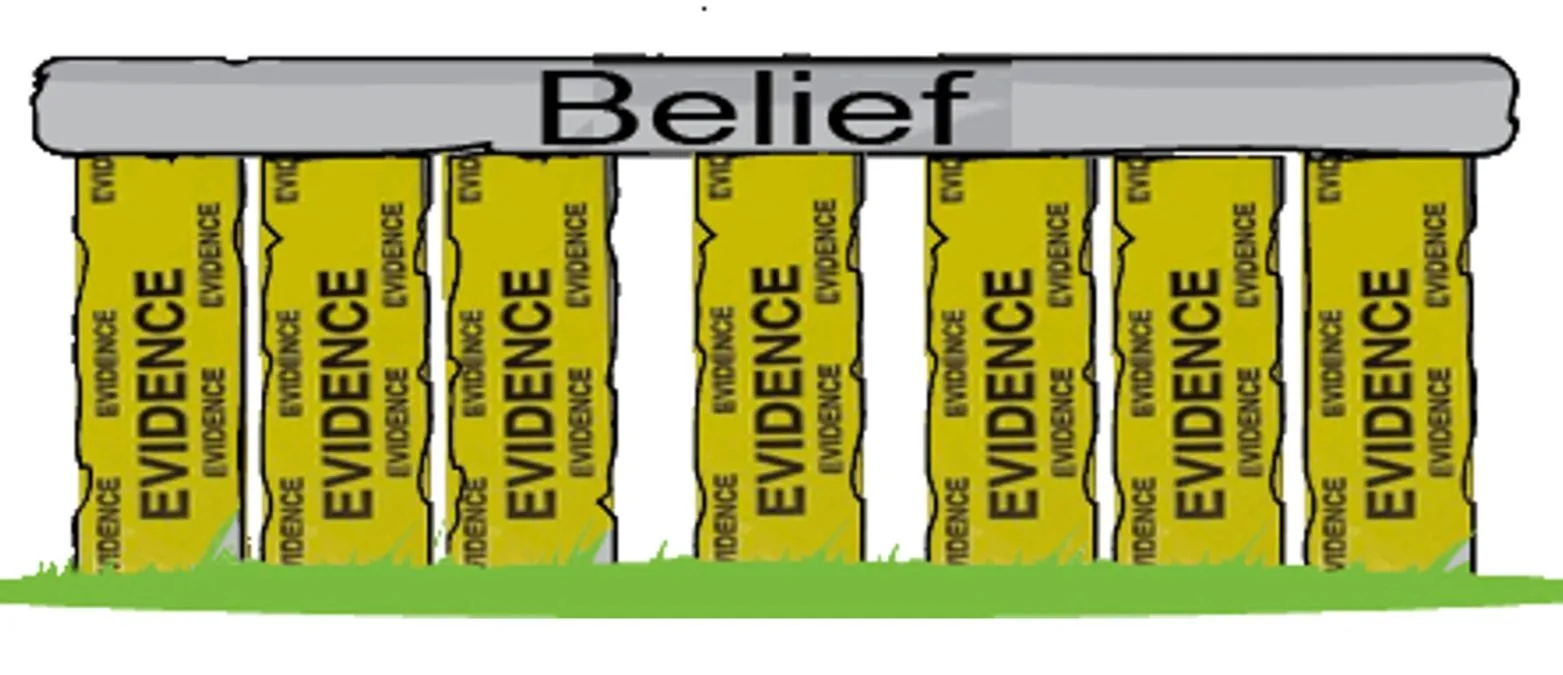
Imagine a belief as a wooden plank suspended above ground. Beneath this plank are vertical supports: pieces of evidence that hold the belief aloft. The more supports beneath the plank, the stronger and more stable the belief becomes. This elegant metaphor reveals how beliefs gain strength through accumulated evidence, whether that evidence comes from personal experience, trusted authorities, cultural conditioning, repeated exposure, or emotional resonance.
Consider someone developing the belief "I am capable of learning new skills." The first support might be a childhood memory of mastering riding a bicycle. Another support: the praise of a teacher who recognized potential. A third: the successful completion of a challenging project at work. A fourth: observing others who started as novices and became experts. A fifth: reading research on neuroplasticity that confirms the brain's capacity for growth.
With each additional support, the plank rises higher and becomes more stable. The belief strengthens until it operates automatically, requiring no conscious effort to maintain. Eventually, this person doesn't actively think, "I believe I can learn new skills." They simply approach new challenges with the unconscious assumption that competence is achievable through effort.
The Sources of Evidence
The supports beneath our belief-planks come from remarkably diverse sources, not all of equal validity:
- Direct personal experience: The most visceral form of evidence, though subject to interpretation
- Social proof: What we observe others doing and experiencing
- Authority figures: Parents, teachers, mentors, experts, cultural leaders
- Cultural narratives: The stories our society tells about how the world works
- Media and information: Books, news, entertainment, social media
- Emotional experiences: Particularly powerful events that create lasting impressions
- Reasoning and logic: Conclusions we draw from available information
- Imagination and visualization: Rehearsing possibilities in the mind
The problem, and opportunity, is that the mind does not always discriminate between high-quality and low-quality evidence. A single traumatic experience can install a belief as firmly as a thousand positive ones. A charismatic but wrong authority can shape beliefs more powerfully than accurate but boring information. This is why belief construction is often haphazard rather than intentional, leaving most people with an eclectic mix of empowering and limiting beliefs accumulated by accident rather than design.
Empowering vs. Limiting Beliefs
Not all beliefs serve us equally. Some beliefs elevate and enable; others constrain and diminish.
Empowering beliefs open possibilities. They include beliefs like:
- "Challenges help me grow"
- "I can learn from failure"
- "My effort matters"
- "I have agency in my life"
- "The world contains opportunities"
- "I am worthy of success and happiness"
These beliefs create what psychologists call a positive feedback loop. They encourage action, and action generates results, and results reinforce the original belief. The person who believes "I can learn from failure" treats setbacks as data rather than verdicts, continues to engage despite difficulties, and eventually succeeds, thereby proving the belief correct.
Limiting beliefs close possibilities. They include beliefs like:
- "I'm not the type of person who..."
- "This is just how I am"
- "I've tried before and failed"
- "Success is for other people"
- "The world is stacked against me"
- "I don't deserve good things"
These create a negative feedback loop. They discourage action, inaction prevents results, and the absence of results reinforces the belief. The person who believes "I'm not good at meeting new people" avoids social situations, never develops social skills, and thereby confirms their original belief.
The tragedy of limiting beliefs is that they often masquerade as objective descriptions of reality rather than subjective interpretations that could be changed. The person caught in their grip says "I am just not a creative person" with the same certainty with which they might say "I am five feet tall," as if personality were as fixed as bone structure.
The Tyranny and Liberation of Identity Beliefs
Among all beliefs, identity beliefs (those that use the formulation "I am") wield unique power. Identity beliefs don't just describe what we think; they define who we think we are.
The Gravitational Pull of Identity
When we say "I am an anxious person," "I am not athletic," or "I am someone who gives up easily," we are not merely describing temporary states or behaviors. We are declaring essential characteristics that feel immutable. These declarations become self-fulfilling prophecies with remarkable reliability.
This is because human beings possess a powerful drive for internal consistency. We are deeply uncomfortable when our actions contradict our self-concept. This discomfort (what psychologists call cognitive dissonance) creates psychological pressure to behave in ways that confirm our identity beliefs, even when those behaviors are self-destructive.
The person who believes "I am undisciplined" will unconsciously sabotage their own attempts at discipline because success would create the intolerable discomfort of violating their self-concept. It's easier to fail in a way that confirms "who I am" than to succeed in a way that challenges it.
Identity, Character, and Values
Identity beliefs form the core of what we call character. If beliefs are the planks of our psychological structure, identity beliefs are the foundation on which everything is built. They determine not just what we do in specific situations, but how we show up consistently across time and circumstance.
Character emerges from the intersection of identity, beliefs, and values. Values are also foundational beliefs, and they inform our judgments about what matters: what we consider good, important, worthy of pursuit, or protection. When identity beliefs align with values, we experience integrity, that sense of wholeness that comes from being who we believe we should be.
Consider someone with the value "Honesty is important" and the identity belief "I am an honest person." These two elements create a powerful behavioral attractor. In situations requiring moral choice, this person doesn't laboriously decide whether to tell the truth. They simply act from identity. Dishonesty becomes literally unthinkable because "that's not who I am." (Morality, one might claim, is a societal belief, but that’s an entirely different discussion.)
This reveals both the power and danger of identity beliefs. Positive identity beliefs ("I am resilient," "I am loving," "I am competent") create self-reinforcing cycles of positive behavior. Negative identity beliefs ("I am a failure," "I am unlovable," "I am incompetent") create self-reinforcing cycles of negative behavior. In both cases, we become trapped in our own narratives, continuously gathering evidence that confirms our existing self-concept.
Beliefs rooted in Machiavellian thinking, such as the notion that the ends justify the means, can legitimize unethical actions and pave the way for deeply manipulative and destructive behavior.
The Prison Without Walls
Most limiting beliefs are like a prison door standing alone in an open field. We sit behind this door, convinced of our confinement, never realizing we could simply walk away. The bars we perceive are not even made of iron but of repeated thought patterns, social conditioning, and accumulated "evidence" that may be far less solid than it appears.
The person who believes "I am not creative" remains imprisoned by this belief, never attempting creative expression, never discovering latent capacities, never gathering counter-evidence. Meanwhile, the cell has only a door and no walls. The field stretches endlessly beyond. Freedom requires only recognizing that the belief itself is not an immutable fact but a changeable interpretation.
The System of Systems
Individual beliefs rarely exist in isolation. They cluster, connect, and reinforce one another, forming belief systems: complex networks of interrelated assumptions about how the world works and who we are within it.
Hierarchical Architecture
Belief systems have a hierarchical matrix structure. At the foundation lie core assumptions, often so fundamental that they operate below conscious awareness. These might include beliefs about human nature, the existence of justice, the reliability of cause and effect, or the basic safety or danger of the world.
Upon these foundational beliefs rest supporting beliefs about specific domains: work, relationships, money, health, politics, spirituality. And upon these rest even more specific beliefs about particular situations, people, and choices.
This dynamic fractal architecture means that changing a core belief can cascade through the entire system, toppling or transforming dozens of dependent beliefs. Conversely, trying to change surface beliefs while leaving core beliefs intact often fails because the foundation keeps reconstructing what's built upon it.
Someone trying to develop the belief "I can succeed in business" will struggle if they hold the deeper belief "The world is fundamentally unfair and I always get the short end of the stick." The specific belief about business success has no stable foundation when the core belief about fairness undermines it.
Now imagine this same person combines "I can succeed in business" with "The world is fundamentally unfair and I always get the short end of the stick," and “The ends justify the means.” How do you think that person will behave?
Coherence and Contradiction
Belief systems strive for internal coherence, even at the cost of accuracy. The mind is not a scientist dispassionately seeking truth; it's more like a lawyer building the best possible case for what it already believes. This tendency (confirmation bias) means we actively seek information that supports our existing beliefs while dismissing, forgetting, or reinterpreting information that contradicts them.
This creates echo chambers within our own minds. The person who believes "People are fundamentally selfish" will notice every instance of selfishness while overlooking countless examples of generosity. The person who believes "I always mess things up" will catalog their failures while dismissing their successes as flukes or luck.
Yet belief systems can also contain contradictions that create psychological tension. Someone might simultaneously hold the beliefs "I value family above all" and "Success requires total dedication to work." The conflict between these beliefs creates stress, difficult choices, and a sense of being pulled in opposing directions.
Resolution typically comes through three paths: changing one belief to align with the other, creating a higher-order belief that reconciles the apparent contradiction, or compartmentalizing the beliefs so they don't directly confront each other.
Meta-Beliefs: Beliefs About Believing
At the highest level of the hierarchy exist meta-beliefs: beliefs about beliefs themselves. These are perhaps the most consequential beliefs we hold, yet they often operate entirely below conscious awareness. Meta-beliefs determine not whether we believe specific things, but how we believe, and crucially, whether we believe our beliefs can change.
The Fixed vs. Growth Meta-Belief
Psychologist Carol Dweck's groundbreaking research on mindset illuminates the power of meta-beliefs. Her work reveals that people hold fundamentally different beliefs about the nature of human capacities, and these meta-beliefs profoundly shape their entire approach to life.
Those with a fixed mindset hold the meta-belief that human qualities are carved in stone. Intelligence, talent, personality, and moral character are viewed as fixed traits that we possess in certain amounts. This meta-belief cascades into countless specific beliefs: "I'm either smart or I'm not," "Some people are natural athletes; others aren't," "You can't teach an old dog new tricks."
The fixed mindset creates a particular relationship with challenge and failure. If abilities are fixed, then challenge threatens to expose deficiency. Failure becomes not a temporary setback but a revelation of permanent inadequacy. This meta-belief leads people to avoid challenges that might reveal their limitations, to give up quickly when things become difficult, to feel threatened by the success of others, and to ignore useful feedback.
Those with a growth mindset hold the meta-belief that human qualities can be cultivated through effort, learning, and persistence. Intelligence can be developed. Talents can be trained. Personality can evolve. This meta-belief generates very different specific beliefs: "I can learn this with practice," "My abilities grow when I'm challenged," "Failure is valuable feedback."
The growth mindset creates a radically different relationship with challenge and failure. If abilities can grow, then challenge becomes an opportunity for development. Failure becomes not a verdict but data. This meta-belief leads people to embrace challenges that stretch their current capabilities, to persist in the face of setbacks, to find lessons and inspiration in the success of others, and to actively seek feedback for improvement.
The Profound Implications
The power of these meta-beliefs extends far beyond individual psychology. Dweck's research shows that these beliefs are not merely motivational preferences but rather fundamental frameworks that shape:
- Effort: Fixed mindset people see effort as evidence of inadequacy ("If I were really smart, this would be easy"). Growth mindset people see effort as the path to mastery.
- Obstacles: Fixed mindset people get discouraged or defensive when facing obstacles. Growth mindset people expect obstacles and prepare strategies to overcome them.
- Criticism: Fixed mindset people take criticism personally and defensively. Growth mindset people mine criticism for useful information.
- Success of others: Fixed mindset people feel threatened by others' success. Growth mindset people find lessons and inspiration in others' success.
The meta-belief about changeability literally rewrites how we interpret every experience. The same event (failing a test, receiving criticism, watching someone else succeed) means something fundamentally different depending on the meta-belief through which it's filtered.
Other Consequential Meta-Beliefs
Beyond fixed vs. growth, other meta-beliefs shape our belief systems:
- Epistemological meta-beliefs: How do we know what's true? Do we trust authority, personal experience, scientific evidence, intuition, or tradition?
- Meta-beliefs about belief change: Are beliefs supposed to remain constant (loyalty, consistency) or should they evolve with new evidence (flexibility, growth)?
- Meta-beliefs about certainty: Is certainty desirable and achievable, or is uncertainty an inevitable part of the human condition?
- Meta-beliefs about belief sources: Should beliefs come from internal reflection or external validation? From individual reasoning or collective wisdom?
These meta-beliefs operate as the settings on a camera, determining what comes into focus and what remains blurred, what appears bright and what stays shadowed. Two people can look at identical information and extract opposite conclusions based on differing meta-beliefs about how to interpret evidence.
The Belief System as Destiny
We return now to Gandhi's cascade: beliefs to thoughts to words to actions to habits to values to destiny. This is not metaphor but mechanism. The belief systems we carry, largely unconsciously, literally construct the paths we walk through life.
The Self-Fulfilling Prophecy
Belief systems create self-fulfilling prophecies with remarkable efficiency. The person who believes "People are generally trustworthy" approaches others with openness, receives friendly responses, and has their belief confirmed. The person who believes "People are generally untrustworthy" approaches others with suspicion, receives defensive responses, and has their belief confirmed. Both gather "evidence" that their worldview is correct, neither recognizing that they're generating the very reality they observe.
This extends to beliefs about ourselves. The person who believes "I'm good at connecting with people" makes eye contact, smiles, asks questions, remembers names, and indeed connects well. The person who believes "I'm bad at connecting with people" avoids eye contact, keeps conversations brief, forgets names, and indeed fails to connect. Both can point to abundant evidence that their self-assessment is accurate.
The belief system doesn't just filter reality; it actively constructs reality through the behaviors it generates.
The Ratchet Effect
Belief systems also create what might be called a ratchet effect: they tend to tighten in their current direction rather than loosen. This is because:
- Selective attention: We notice evidence that confirms our beliefs
- Selective memory: We remember experiences that fit our beliefs
- Selective interpretation: We interpret ambiguous situations to align with our beliefs
- Behavioral confirmation: We act in ways that elicit responses confirming our beliefs
This means belief systems tend toward rigidity rather than flexibility. Once established, they defend themselves against contrary evidence through an array of cognitive mechanisms. The conspiracy theorist explains away disconfirming evidence as part of the conspiracy. The pessimist interprets positive developments as temporary flukes. The person with low self-worth dismisses compliments as politeness or pity.
Breaking this ratchet requires conscious awareness and deliberate effort. It requires recognizing that our beliefs are beliefs, not facts, and that the evidence we've accumulated may say more about our selective attention than about objective reality.
Renovating the Foundation
If our belief systems determine our destiny, and if those belief systems were largely constructed unconsciously through the accidents of our particular history, then the urgent question becomes: Can we renovate? Can we consciously rebuild our belief systems to serve us better?
The answer, crucially, depends on our meta-belief. Those with a fixed mindset about beliefs ("I am who I am") will see renovation as impossible. Those with a growth mindset about beliefs ("I can evolve") will see it as challenging but achievable.
You can't build a beautiful new building on a faulty foundation. Before installing empowering beliefs, you must remove limiting beliefs. This is the work of demolition, of unlearning, of consciously deconstructing beliefs that no longer serve.
Three Paths to Belief Change
- Replacement: Build a more powerful, better-supported empowering belief that supersedes the limiting belief. This is the path of actively gathering new evidence, seeking new experiences, and deliberately constructing new supports for a different belief-plank.
- Deconstruction: Challenge and disprove the evidence supporting the limiting belief. This is the path of critical examination, questioning assumptions, and recognizing that much of what we took as fact is actually interpretation.
- Release: Simply let go of the belief, recognizing it doesn't serve you. This is the path of awareness, accepting that some beliefs are like prison cells in open fields, and we can simply walk away.
Each path requires first becoming conscious of the belief itself. Most limiting beliefs operate in darkness, beneath awareness. Shining the light of conscious attention on them is the essential first step. We cannot change what we don't know about. All change begins with awareness.
Conclusion: The Examined Belief System
The unexamined life, Socrates warned, is not worth living. We might add: the unexamined belief system is not worth keeping. Yet most people live their entire lives within belief systems they never chose, never questioned, and never updated.
Our belief systems are the operating systems of our minds, running continuously, determining what we see, how we interpret, what we attempt, and who we become. They were installed gradually, through the accumulation of experiences, messages, observations, and conclusions, much of it before we had the cognitive capacity to evaluate quality or accuracy.
But unlike computers, we need not wait for the manufacturer to release updates. We can examine our own code. We can identify bugs. We can delete corrupted files. We can install new programs. We have, if we choose to use it, the power to consciously revise the very systems that generate our thoughts, shape our actions, and ultimately determine our destiny.
This is not easy work. Beliefs defended themselves with vigor. The mind resists change, clinging to familiar patterns even when those patterns create suffering. But the alternative is to remain prisoners of our own past, living out scripts written by others, becoming through unconscious accumulation rather than conscious creation.
The invitation, then, is to become archaeologists of our own minds, excavating the belief structures that lie beneath our conscious thoughts. To examine each belief with fresh eyes: Where did this come from? What evidence supports it? Does it serve me? Is it even true? And most importantly: What belief would I choose to install if I were designing myself today?
Our beliefs become our destiny only when we remain unconscious of them. Once conscious, once aware, once willing to engage in the difficult work of examination and revision, we gain something precious: the ability to author our own lives rather than merely live out inherited scripts.
This is the promise of understanding belief systems: not certainty about what's true, but freedom to choose what to believe. Not a guarantee of success, but liberation from invisible constraints. Not a finished product, but an ongoing process of conscious evolution. The architecture of belief, once understood, becomes not a prison but a canvas, not a limitation but a possibility.
And that shift in meta-belief, from fixed to growth, from passive to active, from unconscious to conscious, may be the most transformative belief change of all.
Originally published on C.O.R.E Framework.