Questions With Intent
9 min read
About 14 min, read aloud by an AI voice.
A field guide to the questions that build understanding in course design
Names Matter Less Than Intent
Priming question: Does it matter what we call the questions we ask in a course?
Essential understanding: The label on a question matters far less than the care and intent behind it; a well-designed course uses different questions for different jobs.
In The Care Equation, I argued that better care starts with better questions, and that the quality of our questions and the integrity of the answers decide whether asking leads anywhere. The same is true in a classroom.
Many courses run on one kind of question: the recall item at the end of a chapter. A course designed for understanding uses many kinds, each with a distinct job, asked by different people at different moments. This post lays out the kinds I use. The names are a convenience. If your field calls them something else, keep your terms. What matters is that each question is crafted on purpose.
To keep it concrete, I will use one topic from DPT education throughout, fall prevention in older adults, so you can see every type of question working on the same content.
Start With the Understanding
Priming question: What, exactly, should a learner walk away with?
Essential understanding: An essential understanding is a single full-sentence claim about what learners should understand and carry beyond the lesson, and every question in a course should serve one.
An essential understanding is a claim, not a topic. "Fall risk" is a topic. A claim says something about it that a learner can use. A good essential understanding also transfers: it stays true and useful when the learner meets a new patient, a new setting, or a problem the course never covered.
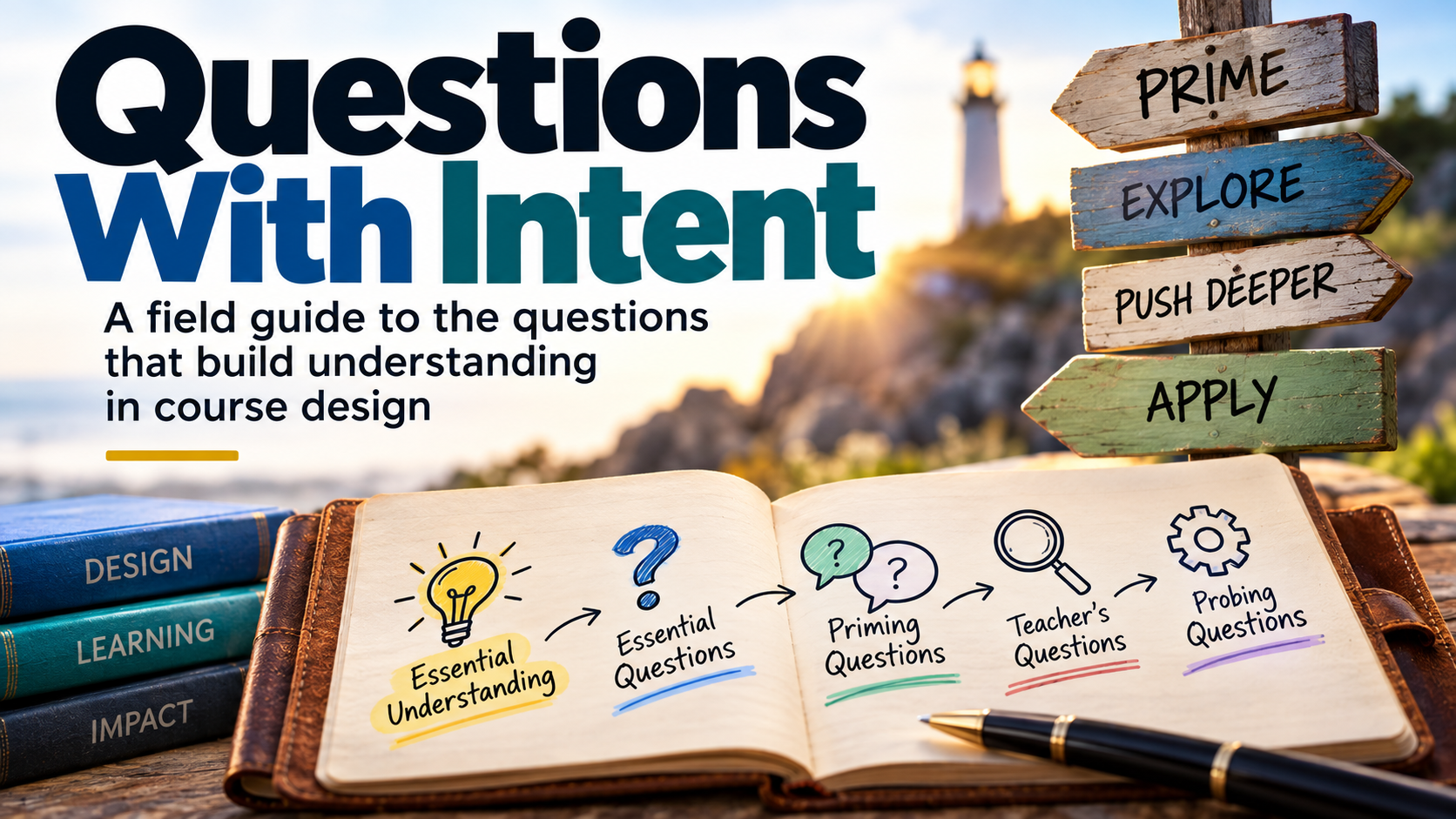
In backward design, the understanding comes first (Wiggins & McTighe, 2005). The only question that comes before it belongs to the designer, not the learner: What do I want the learner to understand from my teaching? Answer that in one sentence and you have your essential understanding. Then decide how you will know learners understand it, and only then what you will teach. The questions in this post are tools for that last step.
Essential understanding: Fall risk emerges from the interaction between a person and their environment, so no single clinic test captures a patient's real risk.
A useful test: if a student remembered only this sentence five years from now, would it still guide their practice?
Before Instruction: Priming Questions
Priming question: Why open a lesson with a question learners cannot yet answer?
Essential understanding: A priming question starts the inquiry by getting learners thinking about the essential understanding before instruction begins, and one well-crafted question often does more than many casual ones.
A priming question starts the inquiry. It is designed to get learners thinking, priming them to contemplate what they are about to learn before you teach it. The research on questions asked before instruction supports the practice, with an important condition. In a preregistered meta-analysis, St. Hilaire et al. (2024) found a moderate benefit for the content the questions targeted (g = 0.54) and almost none for other content in the same lesson (g = 0.04). The benefit was larger when learners committed to a guess (g = 0.65) than when they only read the question (g = 0.22).
Two lessons follow. Aim the priming question at the essential understanding, because attention goes where the question points. And ask learners to commit to an answer before the lesson begins.
Priming question: Your patient scored well on a balance test last week and fell at home yesterday. What might explain that?
Craft it with care. One well-crafted priming question is often better than several casually worded ones. Attention follows the question, so a single question aimed at the heart of the lesson focuses the room, while a scattered list divides attention among details that may not matter.
During Instruction: The Teacher's Questions
Priming question: What different jobs can a teacher's questions do in the moment?
Essential understanding: In real time, teachers use guiding questions to steer, probing questions to reveal thinking, and critical questions to challenge, and mixing them up undermines all three.
Guiding questions lead learners toward a conclusion through reasoning they do themselves. This is the Socratic tradition. A guiding question differs from a leading question, which hides the answer inside the question and lets the learner skip the thinking.
Guiding: What is different about this patient's home compared with our clinic?
Probing questions make a learner's thinking visible without steering it. They come before you decide how to respond, because you cannot correct a misconception you have not seen.
Probing: What makes you say that? Walk me through how you got there.
Critical questions challenge a learner's position and invite a different perspective. The purpose is to deepen thinking, not to win the exchange.
Critical: You recommended grab bars and a shower chair. How might the patient feel about that plan? What about her daughter?
Clarity of intent matters here. A probe delivered in the tone of a challenge shuts students down. A challenge disguised as a guide feels like a trap. Learners respond best when they can tell which kind of question they are being asked.
During Instruction: The Learner's Questions
Priming question: What questions should learners be asking?
Essential understanding: Learner questions are evidence of engagement, and a course should invite three kinds: probing questions that deepen understanding, clarifying questions that repair it, and critical questions that test it.
Probing questions from learners push past what was taught toward what they want to know next.
Probing: Does this apply the same way to patients with cognitive impairment?
Clarifying questions repair a gap in understanding.
Clarifying: Is fear of falling a risk factor, an outcome, or both?
Critical questions from learners push back on what they are learning, often from prior coursework or clinical experience. They are frequently the best sign that a student is integrating new knowledge rather than memorizing it.
Critical: On my clinical rotation we screened everyone with a single balance test. Why isn't that enough?
Clarifying and critical questions carry different risks for the learner. One admits not knowing. The other disagrees with the person who assigns the grade. Invite each one explicitly, and treat both as contributions.
After Instruction: Retrieval, Reflection, and Transfer
Priming question: How do questions asked after a lesson make learning last?
Essential understanding: After instruction, retrieval questions strengthen memory, reflective questions build metacognition, and transfer questions test whether the essential understanding travels.
Retrieval questions ask learners to pull content back out of memory. Roediger and Karpicke (2006) found that students who practiced recalling a passage remembered it much better on a delayed test than students who restudied it, even though restudying looked better on an immediate test. Retrieval feels harder, and that difficulty is part of why it works.
Retrieval: Without your notes, list the categories of fall risk factors we discussed today.
Reflective questions turn the learner's attention to their own learning. Retrieval asks what you know. Reflection asks how you came to know it, how confident you are, and what changed.
Reflective: How has your explanation of the balance-test patient changed since the start of today's session?
Transfer questions check whether the understanding works somewhere new. If an essential understanding is supposed to transfer, a question should test whether it does.
Transfer: How would your assessment change for a patient who lives alone in a second-floor walk-up apartment?
Enduring Questions: The Ones That Never Close
Priming question: What questions should outlast the course?
Essential understanding: Enduring questions are the questions a discipline keeps asking across a career, and every essential understanding we teach is our current best answer to one of them, held open to revision.
McTighe and Wiggins (2013) call these essential questions. I call them enduring questions. The word "essential" invites confusion with the essential understanding, and what defines these questions is that they endure. They are open by design, they recur across a course and across a career, and they are never fully settled.
Enduring question: What keeps an older adult safe at home?
An enduring question is not a step in designing a lesson. A lesson starts with what you want learners to understand, and a priming question gets them thinking about it. An enduring question sits above every lesson. It frames a course, a unit, or a professional life, and it is the reason the lessons exist.
Clinicians have asked this question for as long as there have been clinicians, and they will keep asking it. The essential understanding we teach today is our best answer to it, based on today's evidence. It will not be the last answer.
This framing matters in a clinical field. When we present an essential understanding as the current best answer to an enduring question, we model how clinicians should hold knowledge: firmly enough to act on it, and loosely enough to revise it. Students who learn understandings as final truths are unsettled when the evidence changes. Students who learn them as answers to questions still being asked expect it.
From the Teacher's Questions to the Learner's
Priming question: By the end of a course, who should be asking the questions?
Essential understanding: A well-designed course gradually shifts the work of questioning from teacher to learner, until learners can frame enduring questions of their own.
Mapped by who asks and when, the question types look like this:
| Before | During | After | |
|---|---|---|---|
| Teacher / designer | Priming | Guiding, Probing, Critical (challenge) | Retrieval, Reflective, Transfer |
| Learner | Probing, Clarifying, Critical (pushback) | Reflective, and eventually their own enduring questions |
Enduring questions sit outside the grid. They frame the whole course and return in every phase.
Early in a course, the teacher asks most of the questions. Over time, the teacher should fade that support and hand the questioning to learners: first their probing and clarifying questions, then their critical ones, and finally their own enduring questions. A student who can frame a question worth a career of answers has learned something no test item can measure.
None of This Works Without Safety
Priming question: Why do some classrooms stay silent no matter how good the questions are?
Essential understanding: Learners ask clarifying and critical questions only when it is safe to do so, so the integrity of the learning environment decides whether any questioning strategy works.
In The Care Equation, integrity of answers sits in the exponent because it amplifies or suppresses everything else. The classroom works the same way. A teacher can craft every question with care, but if pushing back feels risky, the learner half of the table above stays empty.
Safety is built in small moments. Thank the student who admits confusion. Respond to pushback with curiosity instead of defense. Say "I don't know" when you don't. Each of those responses tells the room that questions are welcome, and the next question gets easier to ask.
A Question to Close
Look at the questions in your next lesson plan. How many different kinds are there, and who is doing the asking?
Russ L'HommeDieu, DPT, is a physical therapist, educator, and healthcare consultant with more than 35 years of clinical experience. He developed the CORE Framework for instructional design.
References
L'HommeDieu, R. (n.d.). The care equation: Why better care starts with better questions. https://russlhommedieu.com/blog/the-care-equation-why-better-care-starts-with-better-questions
McTighe, J., & Wiggins, G. (2013). Essential questions: Opening doors to student understanding. ASCD.
Roediger, H. L., & Karpicke, J. D. (2006). Test-enhanced learning: Taking memory tests improves long-term retention. Psychological Science, 17(3), 249–255. https://doi.org/10.1111/j.1467-9280.2006.01693.x (opens in a new tab)
St. Hilaire, K. J., Chan, J. C. K., & Ahn, D. (2024). Guessing as a learning intervention: A meta-analytic review of the prequestion effect. Psychonomic Bulletin & Review, 31(2), 411–441. https://doi.org/10.3758/s13423-023-02353-8 (opens in a new tab)
Wiggins, G., & McTighe, J. (2005). Understanding by design (Expanded 2nd ed.). ASCD.