Mighty Metacognition Meets CORE: Teaching Students to Think About Their Thinking in the Age of AI
14 min read
About 21 min, read aloud by an AI voice.
Here is a question worth asking any class of future clinicians: when AI can answer almost anything you put to it, what is left for you to do?
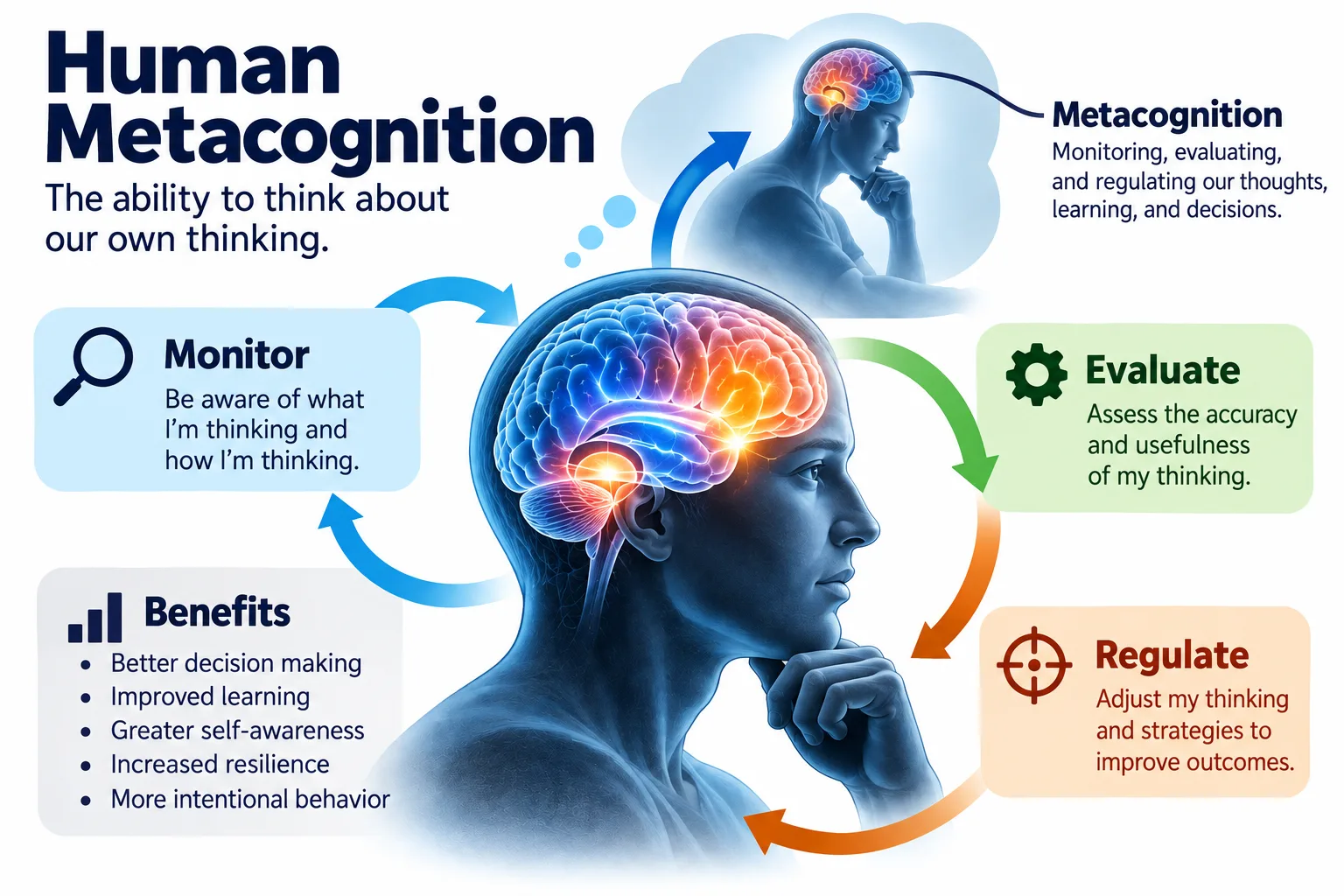
The honest answer is the part AI cannot do for you. Noticing what you do not know. Catching yourself guessing. Deciding, mid-task, that your approach is not working and changing course. That set of skills has a name, metacognition, and it may be the most durable thing we teach.
Sarah Robertson, an associate professor at Grand Canyon University, makes a practical case for teaching it on purpose in her September 2026 eLearn Magazine article, Mighty Metacognition: Leveraging Generative AI and Digital Platforms (opens in a new tab) (Robertson, 2026). Her article is short, specific, and immediately usable. This post walks through her argument, translates her six strategies into a healthcare classroom, and adds a few cautions about where AI belongs in the process and where it does not.
The Argument: Memory Is Not Enough
Robertson starts from a familiar concern. Courses built mainly around transmitting knowledge exercise memory, recall, and association, but an AI-enhanced workplace asks for something more: adaptability, critical thinking, and the capacity to keep learning. She positions metacognition, the ability to reflect on and regulate one's own thinking through planning, monitoring, and evaluating, as the foundation for those skills (Robertson, 2026).
Her most interesting point is about what makes human metacognition distinct. The "learning" inside an AI system is algorithmic. Human metacognition folds in emotion, motivation, and creativity, which is exactly why it remains indispensable as AI takes on more of the routine cognitive load (Robertson, 2026).
This is not a new idea, but it is an urgent one. Twenty-five years ago, Bransford et al. (2000) (opens in a new tab) concluded that metacognitive skills should be taught explicitly across subject areas, because metacognition usually happens as an internal dialogue that many students do not realize matters unless a teacher makes it visible. Wiggins and McTighe (2005) went further, naming self-knowledge as the sixth facet of understanding and arguably the most important one for lifelong learning.
Robertson's contribution is to make that old wisdom concrete for a new moment. Metacognition is invisible work. Our job is to bring it to the surface where students can see it, practice it, and get better at it.
Six Strategies, Viewed Through a Clinical Lens
Robertson offers six strategies that fit within a typical semester, along with digital tools that can support each one. Here is how each might look in a Doctor of Physical Therapy classroom, or any health professions program.
1. Planning: Goals About Learning, Not Grades
Robertson suggests opening a course by asking students what they most want to get out of it. After skimming the syllabus and objectives, students write and share a personal learning goal focused on what they hope to learn rather than the grade they hope to earn (Robertson, 2026).
Benjamin Zander, conductor of the Boston Philharmonic, offers a bolder version of this exercise in The Art of Possibility, the book he wrote with Rosamund Stone Zander. He calls it "giving an A." On the first day of class, every student is told they will earn an A. There is one condition: within two weeks, each student must write a letter dated at the end of the course that begins, "Dear Mr. Zander, I got my A because . . ." The letter is written entirely in the past tense, as if the year has already happened. Phrases such as "I hope," "I intend," and "I will" are not allowed. Zander adds that he is most interested not in the goals reached but in the person the student will have become (Zander & Zander, 2000).
For a DPT course, the letter might begin, "Dear Dr. L'HommeDieu, I got my A because . . ." and go on to describe the clinician the student has become: the stroke survivor's family they could finally explain trunk control to, the confidence they found on their first clinical rotation, the habit of checking their own reasoning before a patient asked them to. When students write that letter, they are delivering their own transparency speech. Yeager (2024) uses that term for the moments when mentors pause to explain what students are being asked to do, why, and how it will help them succeed. The Giving an A letter flips the direction: the student explains the why to themselves, connecting today's effort to the people they will eventually serve. That is Relevance with a capital R, and the student authored it.
As the Zanders put it, this A is not an expectation to live up to, but a possibility to live into. That distinction matters for planning. A goal framed as a grade invites anxiety and comparison. A goal framed as a future self invites ownership (Zander & Zander, 2000).
2. Conscious Monitoring: The Progress Note for Learning
Monitoring is the deliberate, ongoing check on how learning is going. Robertson recommends structured self-reflection questions: What have I achieved so far? What obstacles am I hitting? What have I learned about my own approach? What else could I try? What resources do I need? She also points to progress tracking tools such as Tability and Junia AI, noting that tools used in the workplace offer a second benefit: real-world fluency (Robertson, 2026).
Clinicians already know this pattern. We never write a plan of care and walk away from it. We reassess, document progress, and modify the plan when the patient is not responding. A midterm "progress note" on one's own learning uses a format students will write thousands of times in practice, now pointed inward.
It also puts into practice an idea from The Formula for Better Outcomes: the quality of our outcomes depends on the quality of the questions we ask ourselves, how often we ask them, and how honestly we answer (CORE Framework, 2025a). Conscious monitoring is that formula turned into a habit.
3. Brainstorming: Seeing From More Than One Seat
Robertson notes that brainstorming requires students to take stock of what they know and to consider other viewpoints, which is why perspective-based techniques such as Edward de Bono's Six Thinking Hats work so well. Brainstorming also acts as a quiet form of retrieval practice and reveals gaps in knowledge before they become problems (Robertson, 2026).
This connects to a metaphor I return to often: parallax. Brookfield's (2017) four lenses of critical reflection ask teachers to look at their practice through their own eyes, their students' eyes, their colleagues' eyes, and the research literature. Students benefit from the same discipline. Before a case is fully unpacked, ask them to generate a differential, then argue the plan of care from the patient's perspective, the caregiver's, and the payer's. Each seat reveals something the others hide.
AI can play the role of a thinking hat or a skeptical colleague. The sequence matters, though: students should generate their own ideas first, then invite AI to challenge them.
4. Autobiographical Memory: Why Are You Here?
Robertson describes guided exercises in which students recall specific personal experiences and reflect on the character traits they believe they have and those valued in their chosen field. She notes these activities can be tech-free or supported by an AI platform that guides the student through the reflection, for example with a prompt asking it to lead an autobiographical memory exercise related to a target career (Robertson, 2026).
Many physical therapy students can name the moment they chose this profession: their own ACL rehab, a grandparent's recovery after a fall, a therapist who believed in them when no one else did. Asking students to revisit that story, and to name what that clinician actually did, turns a vague sense of calling into a concrete model of professional identity.
Students should not skip the hard chapters of that story. Zander recalls his own teacher, the cellist Gaspar Cassadó, telling students that they could not play great music unless their hearts had been broken (Zander & Zander, 2000). Many future therapists carry a version of that truth: an injury that ended a season, a parent who never walked again, a long recovery of their own. Reflecting on those experiences is often where compassion for future patients begins.
Two cautions here. First, the reflection has to be the student's own. An AI that asks good questions can be a fine guide; an AI that writes the memory defeats the purpose. Second, remind students not to put identifying details about themselves, family members, or patients into public AI tools. Privacy habits formed in school travel into the clinic.
5. Forecasting: Calibrating Confidence
Forecasting asks students to predict how well they will perform, what might happen next, or how long they can sustain focus, and then to build an adjustment plan before the event happens. Robertson suggests a quick forecasting and adjustment activity before a benchmark quiz or assignment, and mentions the Forest app as a way for students to predict, then check, their focused study time (Robertson, 2026).
In a DPT lab, try this before a practical exam: students predict their performance on each component (patient interview, safety, technique, clinical reasoning) and rate their confidence. After the practical, they compare prediction with reality. The gap is the lesson.
How students respond to that gap matters as much as the gap itself. Zander teaches his students that when they make a mistake, they should lift their arms in the air, smile, and say, "How fascinating!" Mistakes, he argues, are where we finally notice what needs attention (Zander & Zander, 2000). A forecasting miss treated as fascinating becomes data. The same miss treated as failure becomes a reason to stop predicting at all. I recommend trying the arms-in-the-air ritual in lab. It feels silly for about three seconds, and then it changes the room.
This strategy has a timely edge. As I discussed in Why AI Lies and What to Do About It, language models are often rewarded for confident guessing rather than for admitting uncertainty (CORE Framework, 2025c). Forecasting trains the opposite habit in our students: calibrated confidence. A clinician who is confidently wrong is a safety risk. A clinician who knows the boundaries of their knowledge asks for help, looks it up, or refers out, and is both safer and more effective because of it.
The research on this point is sobering. In a vignette study, Meyer et al. (2013) found that physicians correctly diagnosed 55.3% of easier cases but only 5.8% of harder ones, yet their confidence barely moved (7.2 versus 6.4 on a 10-point scale). Higher confidence was linked to fewer requests for additional tests, and accuracy was unrelated to whether physicians asked for more resources at all. Put plainly, the clinicians who most needed help were no more likely to seek it. Berner and Graber (2008) reached a similar conclusion in their review of diagnostic error: overconfidence contributes to misdiagnosis, in part because a clinician who feels certain sees no reason to keep looking.
Knowing the edge of your knowledge is not a weakness to hide. It is a clinical skill, and it shows up as three concrete behaviors:
- Asking for help. A clinical instructor, a senior colleague, or a professional from another discipline adds a second set of eyes. Problems that one clinician misses are often obvious to another, and the patient benefits from the combined judgment.
- Looking it up. Checking a clinical practice guideline or the current evidence turns a hunch into a decision you can defend. It also keeps practice current in a field where yesterday's standard of care is regularly revised.
- Referring out. In a direct access world, physical therapists are often the first clinician a patient sees. Recognizing red flags and signs that a problem falls outside our scope, then referring promptly, can be the most important decision in the episode of care.
Each of these is a metacognitive act: the clinician notices the boundary of what they know before the patient pays the price for it. That makes the humble clinician more effective, not less. Patients reach the right care sooner, fewer interventions are wasted on the wrong problem, and trust grows because the patient sees a clinician who puts their outcome ahead of appearing certain. Forecasting in the classroom, with honest comparison afterward, is where that noticing begins.
6. Shared Metacognition: Thinking Together
The final strategy moves from the individual to the group. In a community of inquiry, members collectively plan, monitor, and evaluate how they are learning, and Robertson notes that this can happen asynchronously over time, not only in a live discussion. She lists collaboration tools such as Google Workspace, Notion, Trello, and Microsoft Teams as supports (Robertson, 2026).
This is ecosystem thinking in action. In an ecosystem rather than an egosystem, success is collective and mistakes become learning opportunities for everyone (CORE Framework, 2024a).
For courses built around readings, social annotation is one of the most direct ways to make shared metacognition visible. Perusall (opens in a new tab) lets students annotate assigned readings together before class, asking questions in the margins and answering one another. In a flipped introductory physics course, Miller et al. (2018) found that most students completed the reading before class, that spacing reading across more sessions predicted better exam performance, and that cohorts using the platform outperformed earlier cohorts using a simpler annotation tool. Two honest caveats: the authors developed the platform, and they note that the comparison does not establish causation. Still, the platform's confusion report, which groups students' questions into common areas of difficulty, is essentially shared monitoring made visible to the instructor.
Clinical parallel: the interdisciplinary team huddle, where PT, OT, nursing, and speech ask together what is working for a patient and what needs to change. Students who practice thinking as a team in school arrive ready to do it on the floor.
A Quick Reference
| Strategy | The question students ask | A DPT classroom example | CORE pillar |
|---|---|---|---|
| Planning | What do I want to be able to do when this course ends? | Write a "Giving an A" letter dated the last day of the course | Relevant |
| Conscious monitoring | What is working, what is not, and what will I change? | Midterm self-reassessment modeled on a progress note | Organized |
| Brainstorming | What do I already know, and what am I missing? | Generate a differential before the case is unpacked | Engaging |
| Autobiographical memory | What in my own story shaped why I am here? | Revisit the clinician who influenced your choice of PT | Relevant |
| Forecasting | How well will I do, and how sure am I? | Predict lab practical performance, then compare | Engaging |
| Shared metacognition | How is our team thinking, and how do we adjust? | Social annotation of readings; team case huddles | Organized |
The Most CORE Advice in the Article
Robertson closes with an honest look at limitations: digital literacy, for students and faculty alike, and the time required to teach these strategies well. Her recommendations are refreshingly modest. Educators should learn a tool and try the metacognitive strategy themselves before assigning it, and they should guide students through only one or two strategies, practiced several times across a semester (Robertson, 2026).
That is Concise in action. Students' time is a non-renewable currency (CORE Framework, 2024b), and six strategies plus a dozen apps would be a course of its own. Choose two. Practice them until they stick. Depth beats breadth when the goal is a habit rather than a handout.
Her advice to test the strategy on yourself first matters just as much. Students learn metacognition far more readily from an instructor who visibly practices it: "Here is what I predicted, here is what happened, and here is what I am changing."
AI as Mirror, Not Ghostwriter
Robertson rightly frames AI tools as supports for metacognitive practice. I would add one firm boundary. Metacognition is the one skill students cannot delegate. If AI does the reflecting, the student receives the reflection's output without its benefit. As I argued in When Disruption Becomes Design, AI works best in education as a mirror that reflects our thinking back to us, not a substitute for it (CORE Framework, 2025b).
A simple rule for students: let AI ask the questions; you write the answers. A prompt as simple as this keeps the cognitive work where it belongs:
"Guide me through a reflection on my progress in this course. Ask me one question at a time and wait for my answer. Do not summarize, interpret, or rewrite my answers for me."
Used this way, AI becomes a patient interviewer that never tires of asking "and why do you think that?" The insight stays with the learner, where it belongs.
Closing Thought
Michelangelo is often quoted as saying that inside every block of marble lives a beautiful statue, and the sculptor's job is simply to remove the excess stone. The Zanders apply the image to education: if we taught this way, comparing one student to another would be pointless, and all our energy would go toward chipping away whatever stands in the way of each student's growing skill, mastery, and self-expression (Zander & Zander, 2000). Metacognition is how students learn to hold the chisel themselves.
Robertson's article is a reminder that the most future-proof skill we can teach is not a body of content but a way of relating to one's own mind: planning deliberately, monitoring honestly, forecasting with humility, and thinking well alongside others. Generative AI makes that skill more valuable, not less.
So here is my question for you: Which one or two of these six strategies could you practice with your students several times this term, and what would you need to try on yourself first?
References
Berner, E. S., & Graber, M. L. (2008). Overconfidence as a cause of diagnostic error in medicine. The American Journal of Medicine, 121(5 Suppl.), S2‐S23. https://doi.org/10.1016/j.amjmed.2008.01.001 (opens in a new tab)
Bransford, J. D., Brown, A. L., & Cocking, R. R. (Eds.). (2000). How people learn: Brain, mind, experience, and school (Expanded ed.). National Academy Press. https://doi.org/10.17226/9853 (opens in a new tab)
Brookfield, S. D. (2017). Becoming a critically reflective teacher (2nd ed.). Jossey-Bass.
CORE Framework. (2024a, August 11). Faculty attitudes: The power of ecosystem dynamics. https://russlhommedieu.com/blog/faculty-attitudes-the-power-of-ecosystem-dynamics
CORE Framework. (2024b, August 10). Respecting a learner's resources. https://russlhommedieu.com/blog/respecting-a-learners-resources
CORE Framework. (2025a, August 7). The formula for better outcomes. https://russlhommedieu.com/blog/the-formula-for-better-outcomes
CORE Framework. (2025b, May 30). When disruption becomes design: The impact of AI on higher ed. https://russlhommedieu.com/blog/when-disruption-becomes-design-the-impact-of-ai-on-higher-ed
CORE Framework. (2025c, September 15). Why AI lies and what to do about it. https://russlhommedieu.com/blog/why-ai-lies-and-what-to-do-about-it
Meyer, A. N. D., Payne, V. L., Meeks, D. W., Rao, R., & Singh, H. (2013). Physicians' diagnostic accuracy, confidence, and resource requests: A vignette study. JAMA Internal Medicine, 173(21), 1952‐1958. https://doi.org/10.1001/jamainternmed.2013.10081 (opens in a new tab)
Miller, K., Lukoff, B., King, G., & Mazur, E. (2018). Use of a social annotation platform for pre-class reading assignments in a flipped introductory physics class. Frontiers in Education, 3, Article 8. https://doi.org/10.3389/feduc.2018.00008 (opens in a new tab)
Robertson, S. (2026, September). Mighty metacognition: Leveraging generative AI and digital platforms. eLearn Magazine. https://doi.org/10.1145/3847992.3744659 (opens in a new tab)
Wiggins, G., & McTighe, J. (2005). Understanding by design (Expanded 2nd ed.). ASCD.
Yeager, D. S. (2024). 10 to 25: The science of motivating young people. Avid Reader Press.
Zander, R. S., & Zander, B. (2000). The art of possibility: Transforming professional and personal life. Harvard Business School Press.