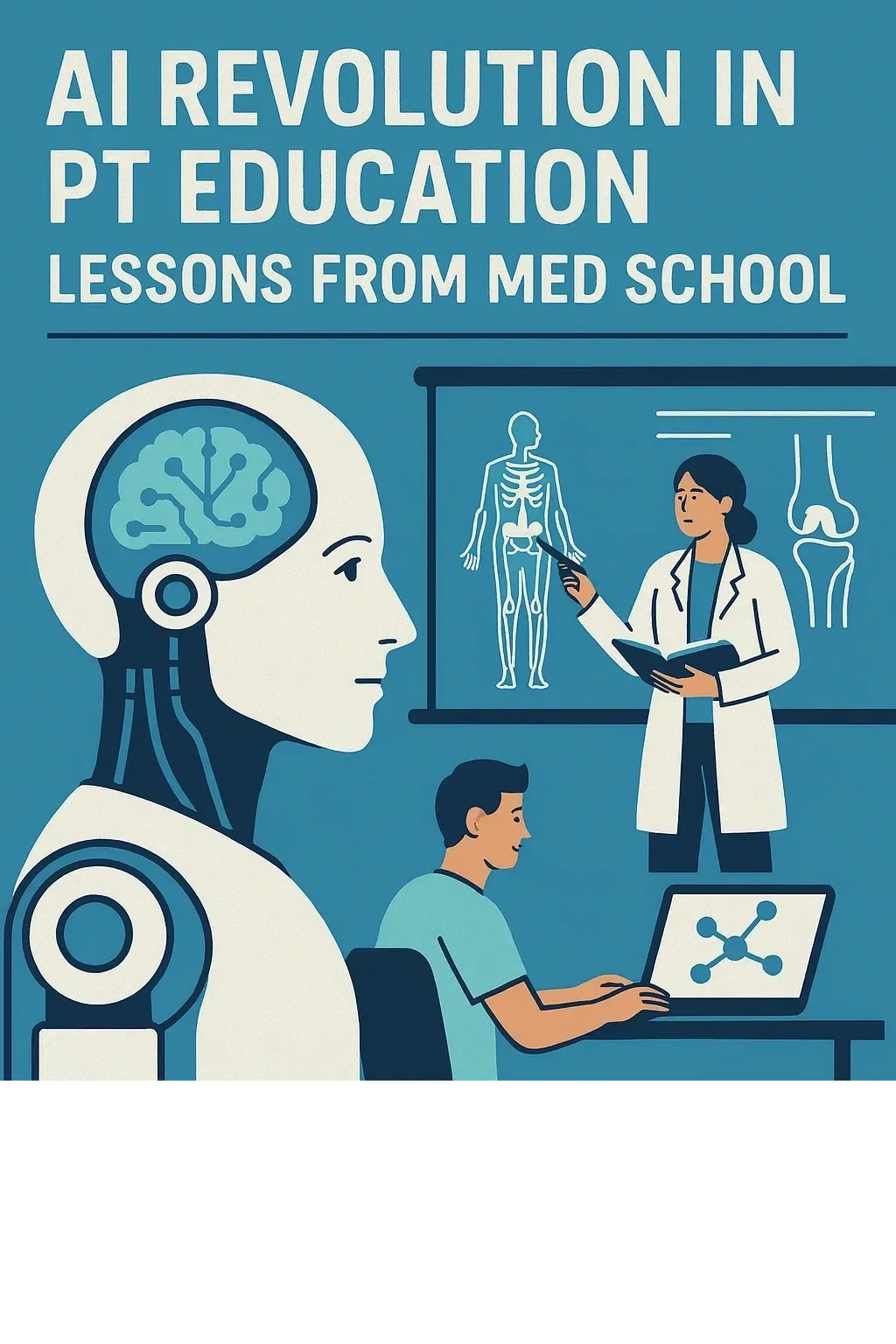
AI Revolution in PT Education: Lessons from Med School
7 min read
Log entry, 202509271845: We have created machines that learn and teach one another. We are unsure how they do it, and we are certainly not in control of the internal world they are creating among themselves. While this generative technology holds great promise for humanity, it has also raised concerns about its potential for unintended and intentional misuse. As we grapple with this issue, scholars from every corner of academia are considering ethical frameworks and policies to rein in the maelstrom emanating from this Pandora's box. What seems palpable is that the wave is surging faster than our ability to adapt to it.
While this may seem like the opening paragraph to a futuristic scifi epic, it’s not. It’s just setting the scene for the state of human-AI relations in late 2025.
In our not-so-little corner of the world, artificial intelligence is rapidly transforming both healthcare and healthcare education, and DPT training is no exception. As educators, we don’t have time to see how this plays out. AI is here, and the moment of “don’t use AI” as academic policy passed us by in a literal flash.
We need to have frameworks that help us leverage the technology and monitor for its dangers as we build the next generation of technically competent, skillful, innovative, and compassionate PTs.
A groundbreaking review just published in the New England Journal of Medicine provides crucial insights for how clinical educators can effectively supervise and integrate AI use in healthcare training (Abdulnour et al., 2025). While focused on medical education, the principles outlined in this seminal work offer invaluable guidance for Doctor of Physical Therapy (DPT) programs navigating the promise and perils of AI integration.
The AI Educational Landscape: Promise vs. Peril
The Promise: Enhancing Learning Through AI
AI technologies, particularly large language models, offer unprecedented opportunities for DPT education. These tools can enhance knowledge recall, provide just-in-time feedback during clinical rotations, and support simulation-based learning experiences. For physical therapy students learning complex movement analysis, exercise prescription, or treatment planning, AI can serve as a cognitive off-loading tool, freeing up mental resources for higher-order clinical reasoning (Abdulnour et al., 2025).
Consider a DPT student analyzing gait patterns. AI could assist with initial data processing and pattern recognition, allowing the student to focus on interpreting findings within the broader clinical context and developing comprehensive treatment strategies. This represents the ideal of AI as a collaborative partner in learning.
The Peril: Risks of Over-Reliance
However, the integration of AI in DPT education is not without significant risks. The same study highlights three critical concerns that physical therapy educators must address:
Deskilling: Students may lose previously acquired skills when they become overly dependent on AI assistance. For instance, if students consistently rely on AI for exercise prescription, they may lose the ability to independently design therapeutic interventions.
Never-skilling: Students may fail to develop essential competencies altogether. A DPT student who uses AI for all clinical documentation might never develop the critical skill of synthesizing assessment findings into coherent clinical narratives.
Mis-skilling: Perhaps most concerning, students may develop incorrect behaviors based on AI errors or biases. Given that AI operates as an unpredictable "black box" with limited reasoning transparency, students may unknowingly incorporate flawed recommendations into their clinical practice.
The DEFT-AI Framework: A Structured Approach for DPT Education
The authors propose the DEFT-AI framework (Diagnosis, Evidence, Feedback, Teaching, and AI recommendations) as a structured approach to promoting critical thinking and AI literacy during learner-AI interactions (Abdulnour et al., 2025). This framework can be readily adapted for DPT education:
Diagnosis
Before using AI, students should clearly articulate their clinical hypothesis and reasoning. For example, when evaluating a patient with low back pain, students should first formulate their own assessment of movement dysfunctions, potential diagnoses, and contributing factors before consulting AI tools.
Evidence
Students must identify and evaluate the evidence supporting their clinical reasoning. This step encourages DPT students to ground their thinking in research and clinical evidence rather than immediately deferring to AI-generated responses.
Feedback
Students should seek feedback on their reasoning process from both AI tools and human supervisors. This dual feedback mechanism helps identify discrepancies between human clinical reasoning and AI recommendations, fostering critical evaluation skills.
Teaching
Clinical instructors must explicitly model critical thinking when interacting with AI. When supervising students, educators should demonstrate how to question AI outputs, verify recommendations against established evidence, and integrate AI insights with clinical judgment.
AI Recommendations
Finally, students should learn to critically evaluate AI-generated recommendations, understanding both their potential value and limitations within the specific context of physical therapy practice.
Adaptive Practice: Balancing Efficiency and Innovation
The concept of adaptive practice (the ability to shift fluidly between efficient, familiar behaviors and innovative, flexible problem-solving) is particularly relevant for DPT education (Abdulnour et al., 2025). Physical therapy practice requires constant adaptation to unique patient presentations, varying clinical environments, and evolving evidence.
The authors describe two distinct AI use behaviors that DPT educators should recognize and teach:
Cyborg Behavior: This involves tight intertwining of the user and AI for each task, with the clinician and AI working collaboratively throughout the clinical reasoning process.
Centaur Behavior: This involves division of tasks between user and AI, with the clinician maintaining critical oversight and delegating specific functions to AI while retaining overall control of the clinical decision-making process.
DPT students must develop the ability to shift between these behaviors based on task complexity and clinical risk. For routine documentation tasks, a cyborg approach might be appropriate, while complex differential diagnosis requiring clinical expertise should maintain centaur behavior with strong human oversight.
Practical Implementation Strategies for DPT Programs
Faculty Development and Shared Learning
One of the most significant challenges identified in the research is that many students are more technologically adept with AI tools than their supervisors (Abdulnour et al., 2025). DPT programs must embrace shared learning environments where faculty and students can explore AI capabilities and limitations together. This approach acknowledges that AI literacy is an evolving competency that requires ongoing development for both learners and educators.
Verify, Then Trust
The authors emphasize that "pausing to critically appraise AI outputs should become a standard habit in clinical training" (Abdulnour et al., 2025). DPT programs should explicitly teach students to verify AI recommendations against established clinical evidence, professional guidelines, and their own clinical reasoning before implementation.
Integration with Clinical Reasoning Models
DPT programs should integrate AI supervision strategies with existing clinical reasoning frameworks. For example, when teaching the International Classification of Functioning, Disability and Health (ICF) model, instructors can demonstrate how AI tools can assist with data organization while emphasizing the continued need for human synthesis and interpretation.
Implications for Clinical Education
The integration of AI in DPT education represents more than simply adopting new technological tools; it requires fundamental changes in how we approach clinical supervision and education. As noted in the research, this is "not just about new tools, it's about preparing clinicians to think critically, adapt, and lead in an AI-enabled future" (Abdulnour et al., 2025).
DPT clinical instructors must model appropriate AI use, demonstrate critical evaluation of AI outputs, and create learning environments where students can safely explore both the benefits and limitations of these technologies. This requires a shift from traditional apprenticeship models to more collaborative learning approaches that acknowledge the rapidly evolving nature of AI technology.
Future Directions and Recommendations
DPT programs should consider implementing the following strategies based on the insights from this research:
- Develop AI literacy curricula that explicitly address both technical competencies and critical thinking skills needed for safe AI use in physical therapy practice.
- Create structured supervision protocols that incorporate the DEFT-AI framework into clinical education experiences.
- Establish guidelines for appropriate AI use across different phases of DPT education, from foundational sciences through advanced clinical practice.
- Invest in faculty development to ensure clinical instructors are prepared to model and teach appropriate AI integration.
- Implement assessment strategies that evaluate students' ability to critically evaluate and appropriately utilize AI tools in clinical decision-making.
Conclusion
The integration of AI in DPT education presents both unprecedented opportunities and significant risks. By adopting structured frameworks like DEFT-AI and emphasizing the development of critical thinking skills, physical therapy educators can harness the promise of AI while mitigating its potential perils. The goal is not to resist technological advancement but to prepare future physical therapists who can think critically, adapt to evolving technologies, and lead in an AI-enabled healthcare environment.
As we navigate this technological revolution, we must remember that the heart of physical therapy practice (the therapeutic relationship between clinician and patient) cannot be replaced by artificial intelligence.
Our educational approaches must ensure that AI enhances rather than diminishes the human elements that make physical therapy practice both an art and a science.
References
Abdulnour, R. E., Gin, B., & Boscardin, C. K. (2025). Educational strategies for clinical supervision of artificial intelligence use. New England Journal of Medicine, 393(8), 786-797. https://doi.org/10.1056/NEJMra2503232 (opens in a new tab)
Author Note: This blog post adapts key findings and recommendations from medical education research for application in Doctor of Physical Therapy programs. Physical therapy educators are encouraged to consider these principles while developing program-specific policies and procedures for AI integration.
Originally published on C.O.R.E Framework.