The Evolution of Bloom's Taxonomy—From Pyramid to Wedge
15 min read
Introduction: The Knowledge Transfer Problem
Picture this: You've just delivered what you believe was a crystal-clear lecture. Your slides were polished, your examples were apt, and your explanations were methodical. You covered everything students needed to know. Then the exam results come back, and your heart sinks. Despite your clarity, despite your preparation, something fundamental didn't connect. The students didn't "get it."
I've had this happen. How about you? This experience reveals a profound misalignment at the heart of traditional education: the gap between what we teach and what students actually learn. It's a gap that Bloom's Taxonomy, and its subsequent evolutions, seek to bridge.
But Bloom's Taxonomy is far more than just an educational tool or pedagogical framework; it represents a fundamental shift in how we conceptualize learning itself. It's the difference between viewing education as a transfer of information from expert to novice, and understanding it as the cultivation of increasingly sophisticated cognitive capabilities. As we educators are fond of saying, "It's a process."
The Revolutionary Insight of 1956
When Benjamin Bloom and his colleagues published their Taxonomy of Educational Objectives as a pyramid in 1956, they were addressing a problem that had plagued education for generations: the lack of a common language for discussing educational goals. Before Bloom, educators spoke about "teaching critical thinking" or "ensuring students understand the material," but these terms meant different things to different people. There was no shared framework for distinguishing between different types and levels of learning.
Bloom's insight was deceptively simple yet profoundly important: not all learning is created equal. There are qualitatively different levels of cognitive engagement, and these levels can be organized hierarchically. At the foundation sits basic knowledge retention, which is the ability to recall facts, terms, and concepts. Above this, Bloom identified comprehension, application, analysis, synthesis, and evaluation as progressively sophisticated cognitive operations.
The pyramid structure of the original taxonomy wasn't arbitrary. It reflected a genuine pedagogical reality: you need foundational knowledge before you can apply it, you need to apply concepts before you can analyze them effectively, and you need analytical capability before you can evaluate or synthesize information in meaningful ways. Each level builds upon the previous one, much like floors in a building. It was oddly reminiscent of Abraham Maslow’s hierarchy of needs pyramid, created just 13 years earlier. But, more on that comparison in another post.
The Hidden Problem with the Pyramid
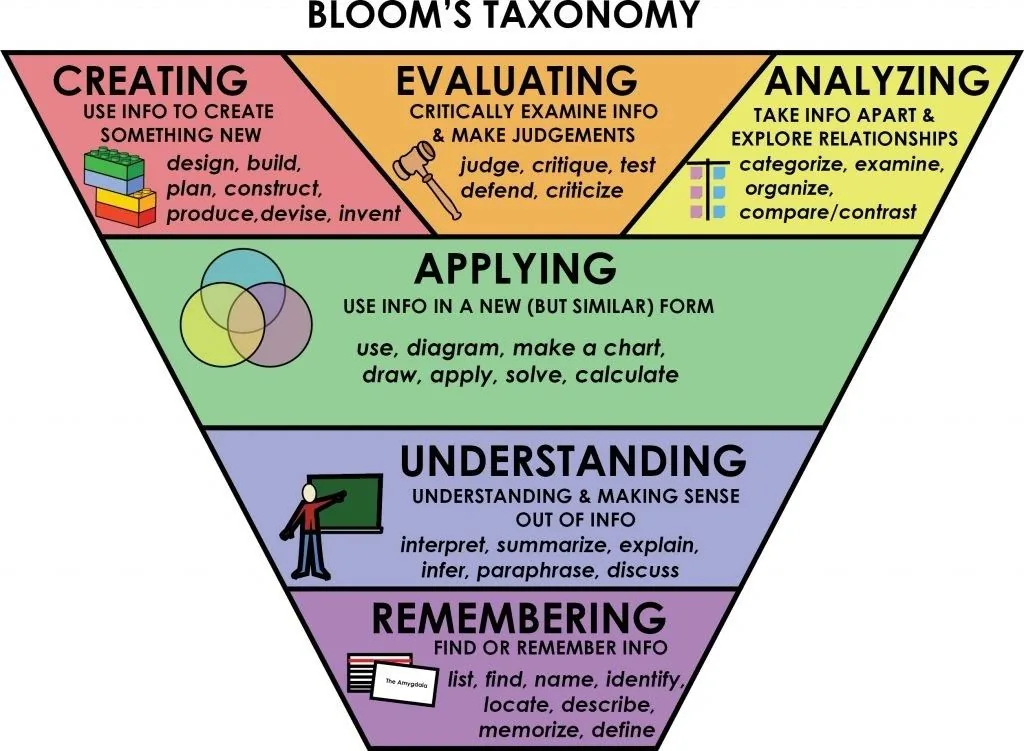
That pyramid shape, as elegant as it was, reveals some hidden limitations. With its broad base of knowledge and narrow peak of evaluation, it inadvertently suggested something about educational priorities: that most of our teaching should focus on knowledge transmission, with only a small amount devoted to higher-order thinking.
This visualization reinforced the very model of education it should have challenged: the "empty vessel" approach, where students are containers to be filled with knowledge. This was undoubtedly my initial approach. I spent a lot of time obsessing over topics, coverage, and the content to be "delivered" to students. The language itself is revealing: delivered, covered, imparted. These are one-way transactions, not processes of cognitive development.
The pyramid also emphasized knowledge as a static thing, to be possessed and recalled. But as subsequent research in cognitive psychology revealed, knowledge without the ability to manipulate, apply, and transform it is of limited value. We don't just want students to know things; we want them to be able to do things with what they know.
The 2001 Revolution: From Nouns to Verbs
When Lorin Anderson and David Krathwohl convened their team of cognitive psychologists, educators, and assessment specialists in 2001, they weren't just tweaking Bloom's Taxonomy; they were fundamentally reimagining it. Their revision represented a shift from a noun-based framework focused on knowledge to a verb-based framework focused on cognitive processes.
This seemingly small change has enormous implications. The revised taxonomy didn't ask "What knowledge do students have?" but rather "What can students do with knowledge?" The levels became:
- Remember (not "Knowledge")
- Understand (not "Comprehension")
- Apply (preserved)
- Analyze (not "Analysis")
- Evaluate (not "Evaluation")
- Create (not "Synthesis")
Each level became associated with specific action verbs that teachers could use to design learning activities and assessments. For "Remember," verbs include list, define, identify, and recall. For "Understand," you have explain, summarize, interpret, and classify. At the highest level, "Create," the verbs become design, construct, formulate, and generate.
This framework of actionable verbs transformed Bloom's Taxonomy from a theoretical classification system into a practical instructional design tool. Suddenly, educators had concrete language to describe what they wanted students to accomplish. Instead of vaguely hoping students would "understand" a concept, teachers could specify: "Students will be able to explain the relationship between X and Y" or "Students will summarize the main arguments of this text."
The Ascent of Creativity
Perhaps the most significant change in the Anderson-Krathwohl revision was elevating "Create" to the apex of the taxonomy, replacing "Evaluate." This wasn't just semantic reshuffling; it reflected a profound insight about the nature of sophisticated thinking.
Evaluation certainly requires high-level cognitive work. When you evaluate something, you must establish criteria, make judgments based on evidence, and defend your conclusions. But creation is the act of producing something genuinely new by synthesizing existing knowledge, skills, and insights. Creation represents the pinnacle of cognitive achievement.
Think about what happens when a student creates something original: an essay presenting a novel argument, a solution to an engineering problem, a musical composition, a business plan, or a scientific hypothesis. To create, you must first remember relevant information, understand the concepts involved, apply them in a new context, analyze the components and relationships, evaluate what works and what doesn't, and then synthesize everything into something that didn't exist before.
Creation is inherently integrative. It subsumes all other levels of cognitive work while transcending them. The creative act is where learners truly demonstrate that they've synthesized knowledge with evaluation, discernment, and judgment to express something new; a new perspective, framework, or combination of elements.
This shift also aligns with what we increasingly recognize as valuable in the 21st century. In an age where information is ubiquitous and AI can recall and even analyze vast amounts of data, the uniquely human capacity for creative synthesis becomes ever more precious. We don't just need people who know things; we need people who can create new knowledge, solutions, and possibilities.
Educational Gear Grinding
Think about a machine with interlocking gears. For the machine to work, the gears must mesh properly, their teeth need to align precisely so that rotation in one gear drives rotation in the next. When gears are misaligned, they grind, slip, and fail to transfer power. The machine might make noise, generate heat, and show signs of activity, but it doesn't actually produce the intended output. The misalignment prevents the transfer of force from input to output.
Educational design works the same way. When teaching activities (the input gear) and assessment expectations (the output gear) aren't properly meshed, learning power doesn't transfer effectively. Students might appear to be learning (they're attending class, taking notes, studying) but when assessment time comes, the gears slip. The cognitive work they practiced doesn't connect to the cognitive work they're asked to demonstrate.
Consider a common scenario from a biomechanics classroom. The instructor wanted students to understand how the kinetic chain operates during human gait—how muscles, joints, and skeletal structures work together through the phases of the gait cycle. The lectures were comprehensive and clear, covering all the facts: the major muscle groups involved, their anatomical attachments, their primary actions, the phases of gait from heel strike through toe-off.
Then came the assessment. The exam presented a case study of a patient with compensatory gait patterns and asked students to analyze the dysfunction. The question demanded analysis; understanding how a weakness in one muscle group creates compensatory patterns in others, how a limitation in ankle dorsiflexion affects knee and hip mechanics, how the entire kinetic chain adapts as a system. And students struggled.
The gear problem was clear: The teaching gear was set at "Remember" and "Understand", and it was functioning fine. The students practiced naming muscle groups, identifying gait phases, and describing normal movement patterns. But the assessment gear was set at "Analyze", requiring students to trace cause-and-effect relationships through the kinetic chain, predict compensatory adaptations, and explain how dysfunction in one joint creates system-wide changes. These gears weren't designed to mesh. When exam time came, the gears ground against each other. Students had the anatomical facts (the teaching gear was spinning), but they couldn't transfer that knowledge into clinical reasoning about gait dysfunction (the assessment gear barely moved).
The Alignment Principle
This speaks to a fundamental principle: the learning experiences you provide must align with the cognitive level you expect students to demonstrate. This seems obvious once stated, but it's violated constantly in educational settings.
If you want students to apply concepts, you must give them practice applying those concepts, not just hearing about applications. If you want them to analyze, you must guide them through analytical exercises. If you want them to create, you must provide opportunities for creation with appropriate scaffolding and feedback.
This alignment principle has several important implications:
1. Backward Design Becomes Essential
You must start with clear learning objectives stated in terms of what students will be able to do, then design assessments that measure those capabilities, and only then plan the learning activities that will develop those capabilities. The taxonomy provides the vocabulary for this entire process.
2. Class Time Must Shift
If higher-order thinking is truly the goal, class time must be devoted to practicing higher-order thinking. The traditional model of lectures for knowledge transmission and homework for practice gets it backward. Knowledge acquisition can increasingly happen outside class (through readings, videos, online modules), while precious class time is devoted to application, analysis, evaluation, and creation with expert guidance available.
3. Assessment Must Match Objectives
If your exams only test recall and basic comprehension, students will logically focus on memorization regardless of what you say about valuing critical thinking. Your assessments send the real message about what matters. If you want analytical thinking, ask analytical questions. If you want creativity, design assignments that require creative production.
4. Transparency Matters
Students benefit from understanding the taxonomy and where different activities fall on it. When they recognize that an assignment is asking them to analyze rather than merely summarize, or to create rather than reproduce, they can direct their cognitive efforts appropriately.
From Pyramid to Wedge: Reimagining the Shape of Learning
The evolution from pyramid to "broad wedge" represents more than a visual tweak. It's a reconceptualization of educational priorities and possibilities. The pyramid suggested that knowledge accumulation should dominate educational time and effort, with higher-order thinking as a capstone experience reserved for advanced students or final projects.
The broad wedge tells a different story. Yes, foundational knowledge remains essential. The wedge still has a base. Yes, the application remains important as a middle zone where knowledge meets practice. But the broad top of the wedge suggests that evaluation, analysis, and especially creation should not be rare pinnacle experiences. They should be ongoing, sustained engagements throughout the learning process.
Why the Wedge Makes Sense
Several factors support this reconceptualization:
The Knowledge Explosion
In Bloom's era, knowledge was scarce and access was limited. Today, knowledge is abundant. Maybe too abundant and overwhelming so. The bottleneck isn't accessing information; it's filtering, evaluating, synthesizing, and creating with it. A framework that devotes most educational time to knowledge transmission made sense in 1956; it makes far less sense in 2025.
Cognitive Science Insights
Research has shown that we learn foundational knowledge better when we actively work with it at higher cognitive levels. Trying to apply a concept before fully understanding it, in what researchers call "productive failure", can actually deepen learning. Analysis and creation aren't just goals; they're powerful learning mechanisms for solidifying foundational understanding.
Authentic Transfer
The ability to transfer learning to new contexts is widely recognized as the ultimate goal of education and requires practice at higher cognitive levels. You can't transfer knowledge you've only memorized; you must have experience analyzing, applying, and creating with that knowledge in varied contexts.
Motivation and Engagement
Students find higher-order cognitive work more engaging and meaningful than rote memorization. When learning involves creating something, solving real problems, or engaging in genuine analysis, students are more invested and persistent. The broad wedge recognizes that keeping students in the basement of cognition isn't just pedagogically limiting—it's motivationally deflating.
21st Century Demands
The skills most valued in modern work and civic life cluster at the top of the taxonomy: evaluating information sources, analyzing complex systems, creating innovative solutions, synthesizing insights from multiple domains. Education that doesn't spend significant time developing these capabilities isn't preparing students for the world they'll inhabit.
The Digital Dimension: Andrew Churches and Beyond
Andrew Churches is a New Zealand educator and educational technology specialist who developed Bloom's Digital Taxonomy in 2008. He acknowledges that the tools we use to think, learn, and create shape the cognitive operations themselves. This isn't technological determinism (the idea that tools completely determine thought) but rather recognition that new tools enable new forms of cognitive work while transforming existing forms.
Consider what "creating" meant in 1956 versus 2025:
Then: Creating meant writing essays, building physical models, painting, composing music on paper, designing blueprints, and conducting laboratory experiments.
Now: Creating might mean producing and editing video, coding software, designing interactive visualizations, composing digital music, building virtual environments, programming simulations, developing games, creating databases, generating AI art with sophisticated prompts, or architecting social media campaigns. It also means having an idea, writing code for an Arduino board, combining it with various sensors, designing and 3D printing cases and attachments for these devices, and creating a thing that solves a real-world problem. You could not do that from your spare bedroom in 1956.
The cognitive level (the "create" part) remains constant, but the modalities and possibilities have exploded. Similarly, "analyzing" might now involve using data visualization tools, running statistical software, programming algorithms, creating network maps, or using machine learning to identify patterns.
The Blend of Analog and Digital
However, the future isn't purely digital. It's a blend of analog and digital action verbs and modalities. This is important because:
Different Tools, Different Affordances
Writing by hand engages different cognitive processes than typing. Drawing on paper offers different affordances than digital illustration. Building a physical prototype teaches different lessons than creating a CAD model. The best learning experiences often involve multiple modalities.
Digital Divides Remain
Not all students have equal access to digital tools. A taxonomy that assumes universal digital access would be exclusionary. Maintaining analog options ensures equity.
Skills Transfer Across Modalities
The ability to analyze an argument is fundamentally the same whether you encounter it in a printed book, a podcast, or a video essay. The cognitive skill is more important than the specific medium, though practice with multiple media builds flexibility.
Avoiding Shiny Object Syndrome
New digital tools can seduce us into thinking we're engaging in sophisticated cognitive work when we're really just using flashy tech for low-level tasks. You can use virtual reality for pure memorization, or you can use a pencil and paper for profound creation. The tool doesn't determine the cognitive level; the task does.
Expanding Action Verbs for the Digital Age
Churches and others have proposed additions to the standard Bloom's action verbs that reflect digital capabilities:
Remember: Bookmarking, favoriting, searching, and social networking to find information
Understand: Annotating, categorizing, commenting, subscribing, tagging, "liking" to demonstrate comprehension
Apply: Operating, uploading, playing, sharing, editing, and presenting via digital tools
Analyze: Mashing (combining data sources), linking, reverse-engineering, data mining, meta-tagging
Evaluate: Rating, reviewing, moderating, collaborating in evaluation, testing hypotheses digitally, curating
Create: Programming, filming, animating, blogging, podcasting, video blogging, remixing, wiki-building, publishing, directing, broadcasting
These expanded verbs don't replace traditional ones; they complement them, offering educators a richer palette of possibilities for designing learning experiences.
The Taxonomy of Taxonomies: Navigating Multiple Frameworks
It's possible that we need "a taxonomy of taxonomies". Bloom's isn't the only framework for thinking about learning:
- SOLO Taxonomy (Structure of Observed Learning Outcomes) describes levels from pre-structural through uni-structural, multi-structural, relational, to extended abstract
- Webb's Depth of Knowledge identifies four levels: recall, skill/concept, strategic thinking, and extended thinking
- Fink's Taxonomy of Significant Learning includes foundational knowledge, application, integration, human dimension, caring, and learning how to learn
- Biggs' Constructive Alignment emphasizes the relationships between objectives, activities, and assessment
Each framework offers different insights and emphases. So which should you use?
The Pragmatic Synthesis
There's no dogma. Look at various frameworks and synthesize from them the elements that align with your priorities, discipline, and students. The point isn't taxonomic purity; it's instructional effectiveness.
This might mean:
- Using Bloom's broad categories but Webb's DOK to think about complexity within each level
- Employing SOLO to understand how students progress from fragmented to integrated understanding
- Borrowing Fink's "learning how to learn" to emphasize metacognitive development
- Using Churches' digital extensions while maintaining analog options
The framework serves you; you don't serve the framework. If thinking about different levels of cognitive work helps you design better learning experiences, regardless of which specific taxonomy you reference, you're using it well.
Creating Your Own Framework
At the highest level of instructional design, you might create your own taxonomy. This isn't hubris; it's thoughtful customization. Your discipline, your students, your institutional context, and your learning goals are unique. A framework that perfectly captures what you're trying to achieve might need to be custom-built.
For example:
- A music teacher might develop a taxonomy specific to musical understanding, from basic rhythm recognition through performance to composition and improvisation
- A medical educator might create a taxonomy for clinical reasoning, from pattern recognition through differential diagnosis to treatment design
- A writing teacher might build a taxonomy from mechanical correctness through rhetorical awareness to voice development and genre innovation
The act of creating your own framework forces you to articulate what truly matters in your domain—what the levels of sophistication really look like, how they build on each other, and what cognitive operations distinguish novice from expert performance.
Evolving the CORE Framework
This process of evolution and customization isn't just theoretical; it's how frameworks develop and deepen over time. I created the CORE framework (Concise, Organized, Relevant, and Engaging) to help myself design learning experiences that respect learner time as currency and prioritize user experience. But researching and writing this exploration of Bloom's Taxonomy revealed something important: CORE was incomplete.
What became clear is that while CORE addresses how to deliver learning experiences, it doesn't fully address what cognitive level those experiences should engage. You can create content that's beautifully concise, perfectly organized, deeply relevant, and genuinely engaging, but if it never moves beyond remembering and understanding, you're not enabling the higher-order thinking that leads to true mastery and transfer.
This realization led me to consider CORES, where I add "Synthesize" as a fifth pillar. "Synthesize" encompasses the highest levels of Bloom's Taxonomy: analyze, evaluate, and create. It represents the cognitive work that transforms information into understanding, understanding into insight, and insight into original contribution. When learning is Concise, Organized, Relevant, Engaging, and asks learners to Synthesize, it becomes cognitively complete. That respects not only learner time but learner potential.
Originally published on C.O.R.E Framework.