Rethinking What It Means to Teach
12 min read

Watch video (opens in a new tab)
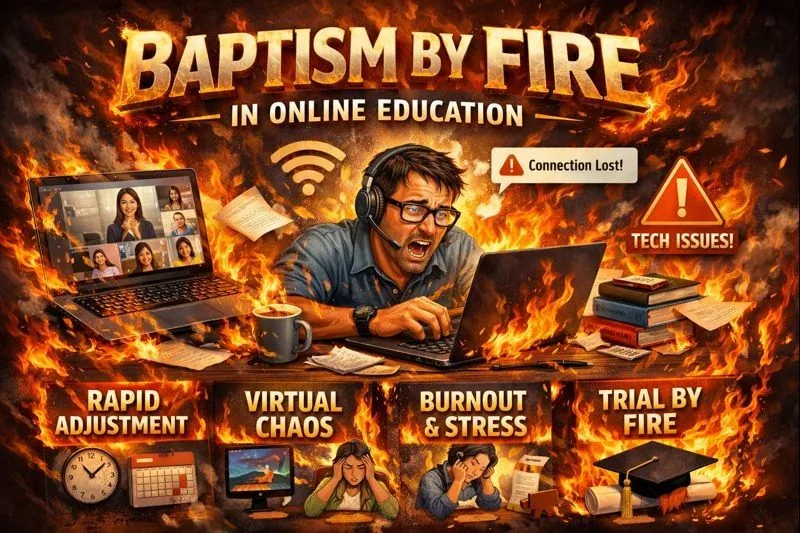
We have all been there. Sitting in a classroom (or logged into a Zoom call) that felt, well, a little uninspired. The slides are clean. The information is accurate. The professor clearly put in hours of preparation. And yet, somehow, almost nobody is actually learning anything.
I want you to picture a specific scene. An online anatomy lecture. Fifty students are logged in, but all you see are black squares. Cameras off. A pre-recorded lecture is playing through perfectly organized but utterly lifeless slides. The information is correct. The structure is clear. But here is the real question: is anyone on the other side of that screen building knowledge? Or are they scrolling their phones, answering texts, and running the lecture as background noise while they fold laundry?
This scenario creates what I would call a double failure. The online content does not stick because passive consumption rarely does. And then precious in-person lab time gets wasted repeating the same material all over again. The students lose twice, and they cannot get that time back.
If you have read my previous posts, you know how seriously I take the idea that students' time is currency (CORE Framework, 2024h). Once spent, it is gone forever. So when we design learning experiences that waste that currency, we are not just being inefficient. We are being disrespectful. Not intentionally, of course. But the outcome is the same.
The good news? The problem is rarely a lack of effort. Educators work incredibly hard. The problem is almost always a flaw in the design process itself. And fixing that design process does not require superhuman talent. It requires a fundamental shift in how we think about what teaching actually is.
Start with the End in Mind
Grant Wiggins, one of the most influential educators of the modern era, made an argument that changed how I think about course design. He observed that too many of us plan our teaching around activities, around what chapter we are on in the textbook, around what we have always done in week three. But we should be focused on the destination. You have to know where you are going before you can draw the map to get there (Wiggins & McTighe, 2005).
This is the core insight behind backward design, and it completely flips the traditional planning script. Instead of starting with activities (Step 3 in the conventional approach), backward design begins at the beginning:
Step 1: What do I want students to understand and be able to do when this is over?
Step 2: How will I know they got it? What evidence will demonstrate understanding?
Step 3: Only now, after answering those two questions, do you plan the actual lessons and activities.
This is not just a neat organizational trick. It is a philosophical commitment. It says: I refuse to fill time with content for content's sake. Everything I design will be in service of a clear, meaningful destination. In my post on Transparency Speeches (CORE Framework, 2025d), I wrote about making Value with a capital V explicit to students. Backward design is how we ensure that Value actually exists in the first place.
If you are a curator of learning, as I argued in "Are You a Curator?" (CORE Framework, 2025a), backward design is your exhibition blueprint. Without it, you are just hanging random artifacts on the wall and hoping visitors make sense of it all.
The Engine: Active Learning
Backward design gives us our destination. But we still need the vehicle to get there. That vehicle is active learning: any instructional approach that gets students to do meaningful things and to think about what they are doing.
This is the shift from passive sponge to active builder. The classroom stops being a broadcast and becomes a workshop. Students are no longer just receiving information. They are constructing knowledge.
Consider a real example. At Harvard, an anatomy instructor reinvented her lab using the jigsaw method. She split the class in half: one group became experts on the bones of the arm, the other on the bones of the leg. Then she reshuffled them into new groups where arm experts had to teach leg experts and vice versa. Instantly, every single student stopped being just a learner. They became a teacher. And the energy in the room changed completely.
This is not just a feel-good story. In my post on Carl Wieman's work (CORE Framework, 2025m), I detailed how active learning has a staggering evidence base behind it. Freeman et al. (2014) conducted a massive meta-analysis of 225 studies and found that active learning in STEM courses reduced failure rates by 55% compared to traditional lectures. Students in active learning classrooms also performed significantly better on concept inventories and exams.
Let that number sink in. A 55% reduction in failure. This is not a marginal improvement. This is the difference between a student who drops out of a pre-med track and one who goes on to become a physician.
As Wieman himself demonstrated, students in his redesigned physics courses performed almost twice as well on concept inventories, and failure rates dropped from 17% to 7% (Deslauriers et al., 2011). More learning. More equity. Less failure. More joy.
The Architecture of Interaction: How Information Flows
But active learning is not just about adding more activities for the sake of it. If we want to truly transform learning, we need to look under the hood and rethink the fundamental architecture of how information moves in our classrooms.
At the most basic level, you have unidirectional flow. This is the classic lecture: information moves one way, from instructor to learner. It can be efficient for laying a foundation, for building a basic mental framework. But if learning stops here, it stays shallow. It is information received, not knowledge built.
The next level is bidirectional flow. Information becomes a two-way street. The instructor asks a probing question. The student responds, revealing their thinking. The instructor provides targeted feedback. The cognitive work is now shared. It is no longer a monologue. It is a dialogue, and feedback is not just a grade at the end but the start of a whole new loop of understanding.
In "Creating a Culture of Trust and Safety with Students" (CORE Framework, 2024b), I discussed how feedback loops are essential for creating cultures of continuous improvement. Bidirectional flow is where those loops begin.
And then there is the most dynamic level: multidirectional flow. Think of a team of doctors diagnosing a complex case study. Or a pilot in a flight simulator. Information is flying everywhere: between students, from the instructor (who is now more of a guide), and from the environment or problem itself. Knowledge gets co-constructed in real time. It is messy, it is complex, and it is exactly how deep professional skills are actually built.
This is ecosystem thinking in action (CORE Framework, 2024c). When information flows multidirectionally, the classroom becomes a living system where every participant contributes to collective learning. Success becomes collaborative, not just individual.
Two Flavors of Dialogue
Even within bidirectional flow, there are important distinctions to make. There is cognitive dialogue, which is focused on the work itself. It is structured, analytical, and asks questions like: How can we make this analysis better?
And then there is coaching dialogue, which is focused on the learner. It is more exploratory, more motivational, and asks: What matters to you about this?
You need both. This echoes what I described in "The Mentor Mindset" (CORE Framework, 2025f): effective teaching is not choosing between being demanding or supportive. It is being both. Cognitive dialogue raises the bar. Coaching dialogue provides the scaffolding to reach it. Together, they create what Yeager et al. (2014) call the conditions for WISE feedback: warmth, clear standards, belief in the student's capability, and specific guidance for improvement.
The Oldest Technology: Story
We have our destination from backward design. We have our engine with active learning. We have the architecture for how information connects. But how do we make it all stick? How do we make learning memorable?
We use the oldest, most powerful teaching tool ever invented: story.
As humans, we are wired for narrative. Lists of facts and figures are abstract. But stories create experiences inside our minds. They light up our emotions and our visual cortex, and they create memories that are exponentially stronger than any bulleted list of key points.
There is a beautiful framework for this called the Pixar Story Spine. It follows a simple structure: "Once upon a time... Every day... But one day... Because of that... Because of that... Until finally..." The secret sauce is in those "because of that" steps. They force causation, not just sequence. And understanding why something happened is the difference between surface knowledge and deep comprehension.
Let me show you how it works with a story you probably already know.
Once upon a time, there was a doctor in the 1840s named Ignaz Semmelweis who worked in a hospital where new mothers were dying at terrifying rates. Every day, more mothers died. But one day, he had a breakthrough. Because of that, he noticed that death rates were dramatically higher in the clinic staffed by medical students who had just come from performing autopsies. Because of that, he hypothesized that "cadaverous particles" were being transmitted from the dead to the living. He mandated handwashing. Until finally, the death rate in his clinic plummeted from a horrifying 18% all the way down to 2%.
The moral of that story is not just "wash your hands." It is that a great story can make a massive abstract idea, like the scientific method, completely unforgettable. When we embed our content in narrative, we stop teaching facts and start creating experiences. And experiences, as I have written about in my work on flow and engagement (CORE Framework, 2024e), are what lead to lasting transformation.
The Real Transformation: A Shift in Identity
So let us pull this all together. We have gone on a journey from identifying a common problem (the lifeless lecture) to uncovering a set of powerful, evidence-based solutions: backward design, active learning, intentional information architecture, and the ancient art of storytelling.
But what this really comes down to is something deeper. It is a fundamental shift in identity.
The old model was the sage on the stage. The focus was on delivering content. Success was measured by how much information the instructor transmitted. And the assumption was that if students did not learn, the problem was with the students.
The new model is the designer of learning experiences. The focus is no longer on the information itself but on creating the conditions, the architecture, and the story that allow learners to actively build their own deep, lasting understanding.
This shift mirrors what I have written about in "Beliefs as Operating Systems" (CORE Framework, 2024a). When we upgrade our fundamental belief about what a teacher is, everything downstream changes. Our planning changes. Our classroom dynamics change. Our relationship with students changes. We stop asking "Did I cover the content?" and start asking "Did my students build understanding?"
In "Responsibility and The Power of Clear Communication" (CORE Framework, 2024t), I argued that the burden of clarity rests on the educator, not the student. When comprehension fails, the question should never be "Why didn't they understand?" but rather "How can I design this more effectively?" The sage blames the audience. The designer iterates on the product.
Where the CORE Framework Fits
Everything in this post connects directly to the CORE Framework. Backward design ensures our content is Concise (no wasted effort) and Organized (structured around clear destinations). Active learning makes content Relevant through application and Engaging through participation. Storytelling wraps it all in a package that respects how human brains actually process, store, and retrieve information.
The information flow architecture also maps beautifully onto CORE. Unidirectional flow, when done well, is Concise and Organized. Bidirectional flow is where Relevance begins, because students reveal what they do and do not understand, allowing us to adapt in real time. Multidirectional flow is peak Engagement, the kind of dynamic, collaborative learning that creates lasting professional competence.
And the designer mindset? That is the CORE Framework's operating system. It is what happens when you stop treating education as a performance and start treating it as a product that needs to deliver real value to real users.
The Final Question
Here is what excites me most about all of this: the shift from sage to designer is not just for people who stand in front of classrooms. It is for all of us. Because we are all lifelong learners, and we are all, in various ways, teaching the people around us.
Every time you onboard a new colleague, you are designing a learning experience. Every time you explain a concept to a mentee, you are choosing between broadcasting and building. Every time you share your expertise, you are either dumping information or crafting a journey.
The research is unambiguous. Active learning works. Backward design works. Story works. The question is not whether these approaches are effective. The question is whether we are willing to redesign our practice with the same rigor and care that we bring to our content expertise.
Because if Carl Wieman taught us anything, it is that real learning begins when we stop lecturing and start listening: to the data, to our students, and to the science of how people actually learn.
So the final question is not just for teachers. It is for you.
What learning experience will you design next?
References
CORE Framework. (2024a, August 18). Beliefs as operating systems: The power of synergistic mindsets. https://coreframework.org (opens in a new tab)
CORE Framework. (2024b, August 12). Creating a culture of trust and safety with students. https://coreframework.org (opens in a new tab)
CORE Framework. (2024c, August 11). Faculty attitudes: The power of ecosystem dynamics. https://coreframework.org (opens in a new tab)
CORE Framework. (2024e, August 15). Manage your energy NOT your time. https://coreframework.org (opens in a new tab)
CORE Framework. (2024h, August 10). Respecting a learner's resources. https://coreframework.org (opens in a new tab)
CORE Framework. (2024t, September 4). Responsibility and the power of clear communication. https://coreframework.org (opens in a new tab)
CORE Framework. (2025a, August 22). Are you a curator? https://coreframework.org (opens in a new tab)
CORE Framework. (2025d, August 18). Transparency speeches. https://coreframework.org (opens in a new tab)
CORE Framework. (2025f, August 13). The mentor mindset. https://coreframework.org (opens in a new tab)
CORE Framework. (2025m, April 11). Beyond the lecture: How Carl Wieman rewired science education. https://coreframework.org (opens in a new tab)
Deslauriers, L., Schelew, E., & Wieman, C. (2011). Improved learning in a large-enrollment physics class. Science, 332(6031), 862–864. https://doi.org/10.1126/science.1201783 (opens in a new tab)
Freeman, S., Eddy, S. L., McDonough, M., Smith, M. K., Okoroafor, N., Jordt, H., & Wenderoth, M. P. (2014). Active learning increases student performance in science, engineering, and mathematics. Proceedings of the National Academy of Sciences, 111(23), 8410–8415. https://doi.org/10.1073/pnas.1319030111 (opens in a new tab)
Wiggins, G., & McTighe, J. (2005). Understanding by design (2nd ed.). Association for Supervision and Curriculum Development.
Wieman, C. (2017). Improving how universities teach science: Lessons from the Science Education Initiative. Harvard University Press.
Yeager, D. S., Purdie-Vaughns, V., Garcia, J., Apfel, N., Brzustoski, P., Master, A., Hessert, W. T., Williams, M. E., & Cohen, G. L. (2014). Breaking the cycle of mistrust: Wise interventions to provide critical feedback across the racial divide. Journal of Experimental Psychology: General, 143(2), 804–824. https://doi.org/10.1037/a0033906 (opens in a new tab)
Originally published on C.O.R.E Framework.