Creating a Culture of Trust and Safety with Students
5 min read
Students are valuable stakeholders in the creation and continuous improvement of curriculum. We want their feedback to be honest, accurate, and, most of all, useful. The reality is that most students don't complete the course evaluations, and if they do, it is because they either have an axe to grind or they are trying to "check a box."
Of course, part of the problem is the surveys themselves. Many course evaluation tools miss the mark when it comes to gathering meaningful insights. We are building course assessment tools designed to evaluate the C.O.R.E. framework. Are your students being guided to meaningful insights? Was my content Concise? Organized? Relevant? Engaging? As educators, we should be able to bake-in highly relevant and engaging course evaluation tools.
After creating better tools, we then have to talk about culture. These are difficult questions for us to answer honestly, but "Are your students embraced by a culture of safety?" "Can they be honest about their experience with your content?" "Do they even have the language or the skills to express constructive criticism?"
The root of the problem lies in the absence of a learning environment that encourages trust and genuine communication, which are essential for eliciting honest and constructive feedback from students.
The Limitations of Current Course Evaluation Tools
Traditional course evaluations tend to fall short in several key areas:
- Relevance Issues: Many evaluation forms contain generic questions that fail to capture the unique aspects of a specific course or teaching method, leading to responses that are broad or lack specificity.
- Complexity Overload: Some evaluations are overly detailed or poorly structured, which can overwhelm students and result in feedback that is rushed or superficial.
- Lack of Engagement: When students perceive evaluations as mere formalities, they are less likely to engage thoughtfully with the process, reducing the value of the feedback provided.
These limitations underscore the need for a different approach to gathering student feedback—one that prioritizes trust, emotional safety, and relevance.
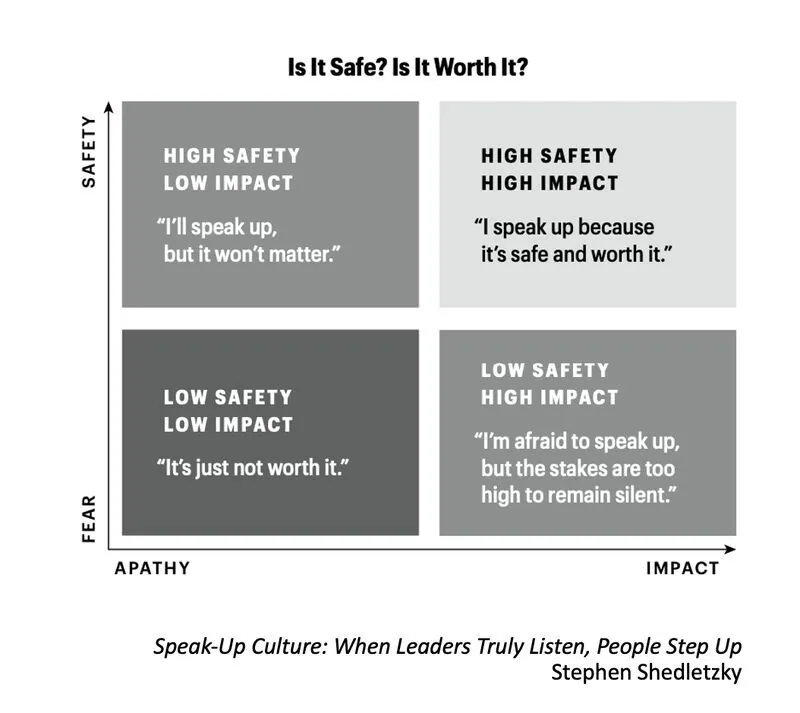
Exploring the "Is It Safe? Is It Worth It?" Matrix
Before a student decides to provide feedback, they often consider two critical questions:
- Is it safe? This question examines whether students feel psychologically safe enough to risk potential repercussions—such as damaged relationships or reduced grades—by offering honest feedback (Edmonson, 2012).
- Is it worth it? This question pertains to whether students believe that providing feedback will lead to positive changes. This concept, known as “perceived impact,” is crucial in determining whether students feel their efforts will be meaningful.
Stephen Shedletzky’s Speak-Up Culture introduces the "Is It Safe? Is It Worth It?" matrix, a framework that highlights the importance of these two factors. According to this matrix, people are more likely to speak up when they perceive both a safe environment and a high likelihood that their input will lead to meaningful outcomes (Shedletzky, 2023).
This matrix visualizes the balance between fear and safety on one axis and apathy versus impact on the other. The goal is to create an environment that fits into the top-right quadrant, where both safety and impact are high. In this optimal zone, students feel secure and believe that their feedback will make a difference, which fosters a healthy and proactive communication culture.
Building Trust and Emotional Safety
Susan David’s concept of Emotional Agility provides further guidance on cultivating an environment where students feel safe and valued. Emotional Agility involves recognizing, understanding, and constructively responding to emotions, both our own and those of others (David, 2016).
For educators, this means being sensitive to the emotional needs of students and creating a learning space where they feel comfortable expressing their thoughts and feelings. When students trust that their emotions will be respected and not dismissed, they are more likely to provide honest feedback. This emotional safety is critical to fostering open communication and encouraging students to engage in meaningful dialogue about their educational experiences. We need to treat students as valuable, trusted stakeholders.
Strategies for Creating a Culture of Trust and Safety
- Ensure Psychological Safety: Utilize the "Is It Safe? Is It Worth It?" matrix by making it clear to students that their feedback is valued and that there will be no negative consequences for honesty. This can be reinforced through transparent communication and ensuring anonymity where necessary.
- Foster Emotional Agility: Create a classroom atmosphere where students are encouraged to share their feelings and experiences. This can be achieved by regularly checking in with students, offering opportunities for anonymous feedback, and responding empathetically to their concerns.
- Implement Effective Feedback Tools: Develop evaluation tools that align with the CORE framework, ensuring that they are concise, well-structured, relevant, and engaging. This will help students provide clear, focused, actionable, meaningful feedback.
- Demonstrate Responsiveness to Feedback: Show students that their feedback leads to real changes, whether in course content, teaching methods, or other aspects of the educational experience. When students see the impact of their feedback, they are more likely to participate actively in the process.
- Lead by Example: Model the behavior you wish to see in your students by being open to feedback yourself. Share how you are using their input to improve the course and thank them for their contributions.
References
David, S. (2016). Emotional agility: Get unstuck, embrace change, and thrive in work and life. Penguin Random House.
Edmondson, A. C. (2012). Teaming: How Organizations Learn, Innovate, and Compete in the Knowledge Economy. Jossey-Bass.
Shedletzky, S. (2023). Speak-up culture: When leaders truly listen, people step up. Page Two Books.
Originally published on C.O.R.E Framework.