The Infinite Game (2019)
7 min read
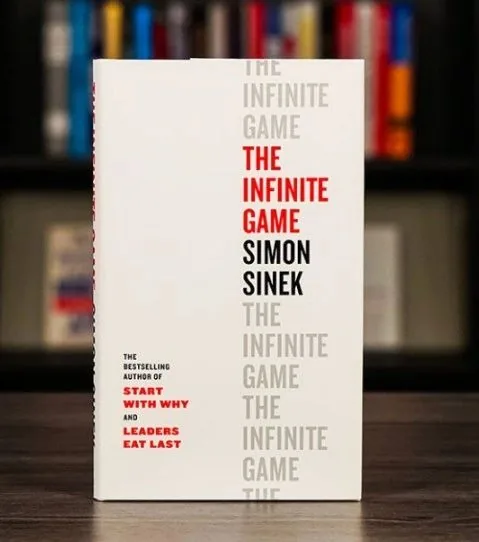
Sinek applies philosopher James Carse's distinction between finite and infinite games to business leadership. Rather than viewing business as a competition to be won, he argues that sustainable success requires an "infinite mindset" focused on advancing a purpose that outlasts any individual player. The book builds on his earlier "Start with Why" framework by explaining how leaders can create organizations that endure through changing circumstances, shifting competitors, and evolving rules. While the core concept is borrowed from Carse's 1986 philosophical work, Sinek translates it into actionable business principles through case studies and practical frameworks.
Author Credentials/Background
Simon Sinek (born 1973) earned a BA in cultural anthropology from Brandeis University and studied law at City, University of London before pivoting to advertising. He worked at prestigious agencies Euro RSCG and Ogilvy & Mather in New York before founding Sinek Partners in 2002. His 2009 TED Talk "How Great Leaders Inspire Action" has over 60 million views and remains one of the most-watched talks in TED history. He serves as an adjunct staff member at the RAND Corporation and has taught strategic communications at Columbia University. His client list includes Microsoft, 3M, the U.S. military branches, and the United Nations. Previous bestsellers include Start with Why (2009), Leaders Eat Last (2014), Together Is Better (2016), and Find Your Why (2017). The Infinite Game became a New York Times and Wall Street Journal bestseller. He is a trained ethnographer who describes himself as an "unshakeable optimist" focused on helping people find fulfillment in their work.
The Big Idea(s)
- Finite vs. Infinite Games: Finite games (sports, chess) have known players, fixed rules, and clear endpoints—someone wins, the game ends. Infinite games (business, politics, life) have no finish line, players come and go, and rules can change. The goal isn't winning but continuing to play.
- Just Cause: A vision of a future state so appealing that people willingly sacrifice to advance it. Not a goal to achieve but an ideal to pursue indefinitely. Must be affirmative (for something, not against), inclusive, service-oriented, resilient, and idealistic.
- Trusting Teams: Psychological safety where people feel they can be vulnerable, admit mistakes, and ask for help without fear of humiliation or punishment. Trust enables innovation and honest communication.
- Worthy Rivals: Competitors aren't enemies to defeat but rivals who reveal your weaknesses and push you to improve. Study them to understand your own blind spots, not to beat them.
- Existential Flexibility: The capacity to make dramatic shifts in business model or strategy to better advance the Just Cause. Not pivoting for survival but proactively disrupting yourself to stay true to purpose.
- Courage to Lead: The willingness to face pressure from finite-minded players (shareholders, boards, analysts) and maintain commitment to the infinite game. Prioritizing long-term vision over short-term metrics.
Who Needs This Book
- Essential for: CEOs and executives feeling trapped by quarterly pressure, leaders building company culture, anyone questioning shareholder primacy
- Highly valuable for: Entrepreneurs defining company purpose, managers building psychological safety, anyone frustrated by short-term corporate thinking
- Useful for: Employees evaluating organizational health, students of business strategy, those interested in game theory applications
If you've watched companies sacrifice their soul for stock price, or wondered why some organizations inspire loyalty while others just extract labor, this book explains the underlying dynamics.
Key Takeaways by Chapter
Chapter 1 - Finite and Infinite Games: Introduces Carse's framework. Business is an infinite game played with finite rules. Problems arise when leaders play finite (trying to "win") in an infinite context. Symptoms include declining trust, employee disengagement, ethical compromises, and organizational decline.
Chapter 2 - Just Cause: The foundation of infinite play. Must be specific enough to guide decisions but idealistic enough to never be achieved. Contrasts weak mission statements ("be the best") with true causes. CVS quitting tobacco sales exemplifies cause-driven decision-making.
Chapter 3 - Cause. No Cause: Examines how organizations lose their cause over time ("cause blindness"). The Founders' Mentality erodes as growth brings bureaucracy. Success can breed finite thinking as protecting gains replaces advancing purpose.
Chapter 4 - Keeper of the Cause: CEOs should be CVO (Chief Vision Officers). Role is stewardship, not ownership. The job is to keep the cause alive and find successors who will carry it forward. Companies belong to their causes, not their leaders.
Chapter 5 - The Responsibility of Business: Critiques Milton Friedman's shareholder primacy theory. Argues this finite thinking has damaged American business. Companies exist to serve customers, employees, and communities—profit is fuel, not purpose. Traces how 1970s shareholder theory led to short-termism.
Chapter 6 - Will and Resources: Two requirements for infinite play: will (the desire to advance the cause) and resources (money, people, etc.). Will without resources leads to burnout. Resources without will leads to soulless operations. Great organizations balance both.
Chapter 7 - Trusting Teams: Deep dive into psychological safety. Leaders create safety by being vulnerable first. The Navy SEALs prioritize trustworthiness over performance when building teams. Trust enables people to admit weakness and ask for help.
Chapter 8 - Ethical Fading: How finite pressure leads to gradual ethical erosion. Small compromises accumulate until the unthinkable becomes normal. Wells Fargo's fake accounts scandal illustrates how metrics-driven culture corrupts. Infinite mindset provides ethical grounding.
Chapter 9 - Worthy Rival: Reframes competition. Sinek shares his own rivalry with Adam Grant—feeling threatened until recognizing Grant as motivation to improve. Rivals aren't enemies but teachers. Apple vs. Microsoft: Jobs saw Gates as rival; Ballmer saw Jobs as enemy.
Chapter 10 - Existential Flexibility: Strategic pivots that advance the cause. Disney's shift from animation to theme parks. Apple's move from computers to consumer electronics. Requires letting go of what made you successful to become what you need to be. Kodak's failure as counterexample.
Chapter 11 - The Courage to Lead: Synthesis and call to action. Infinite leadership requires courage to resist finite pressure from shareholders, analysts, and boards. The choice isn't easy but determines whether organizations inspire or merely exist.
Questions It Provokes
- Is my organization playing finite or infinite? What are the symptoms?
- Do we have a true Just Cause, or just a marketing slogan?
- Would people sacrifice their own interests to advance our purpose?
- Who are my worthy rivals, and what do they reveal about my weaknesses?
- Is ethical fading happening in my organization right now?
- Can shareholder capitalism actually accommodate infinite thinking, or is this idealistic?
- If I left tomorrow, would my organization's cause survive me?
Recommendation Strength
WORTHWHILE for leaders and aspiring leaders in any organization. The core distinction between finite and infinite mindsets is genuinely useful for diagnosing organizational dysfunction and personal leadership choices.
Caution: Critics note that Sinek oversimplifies James Carse's original philosophical framework, sometimes contradicting Carse's actual arguments. The corporate examples (Apple good, Microsoft bad; CVS heroic, etc.) are presented without the nuance that more rigorous analysis would require. Some reviewers find the later chapters repetitive, extending what could be a long article into a full book. The critique of shareholder primacy and Milton Friedman is notably one-sided.
The writing is accessible. . . almost too accessible for readers wanting depth. Sinek's strength is translating complex ideas for general audiences, but this also means the original nuance of game theory gets flattened.
Best approach: Watch Sinek's TED Talk (opens in a new tab) on the topic first. If the concept resonates, the book expands it with examples. For deeper engagement with the original ideas, read James Carse's "Finite and Infinite Games" (1986)—it's shorter, more profound, and more challenging.
Related Resources
- Finite and Infinite Games (Carse, 1986): The philosophical source material. Dense but rewarding; presents the concepts with more depth and nuance.
- Start with Why (Sinek, 2009): Sinek's foundational work. "Just Cause" extends the "Why" concept; reading both shows the evolution of his thinking.
- Leaders Eat Last (Sinek, 2014): Deeper exploration of trust-building and psychological safety. More focused than The Infinite Game.
- Built to Last (Collins & Porras, 1994): Research-based study of enduring companies. More rigorous methodology for similar conclusions about purpose-driven organizations.
- Mindset (Dweck, 2006): The growth/fixed mindset distinction parallels finite/infinite thinking. Different domain, complementary insights.
- Ego Is the Enemy (Holiday, 2016): Similar themes about subordinating self-interest to larger purpose.
Impact beyond business: The book has found audiences in education, military leadership, nonprofit management, and personal development. The framework applies wherever organizations struggle with short-term vs. long-term thinking. Sinek's concepts have been adopted by leadership trainers worldwide, though critics argue his popularization comes at the cost of intellectual rigor.
Amazon: The Infinite Game by Simon Sinek (opens in a new tab)
Originally published on C.O.R.E Framework.