May Contain Lies: The Pursuit of Truth in a World Full of Biases
6 min read
In my blog post from September 3, 2024, Understanding Truth: Navigating to Absolute Reality, I discussed the distinctions between personal, social, and objective truths. Neil deGrasse Tyson’s concept of objective truth—the idea that some truths remain valid regardless of personal beliefs or societal norms—frames this exploration perfectly.
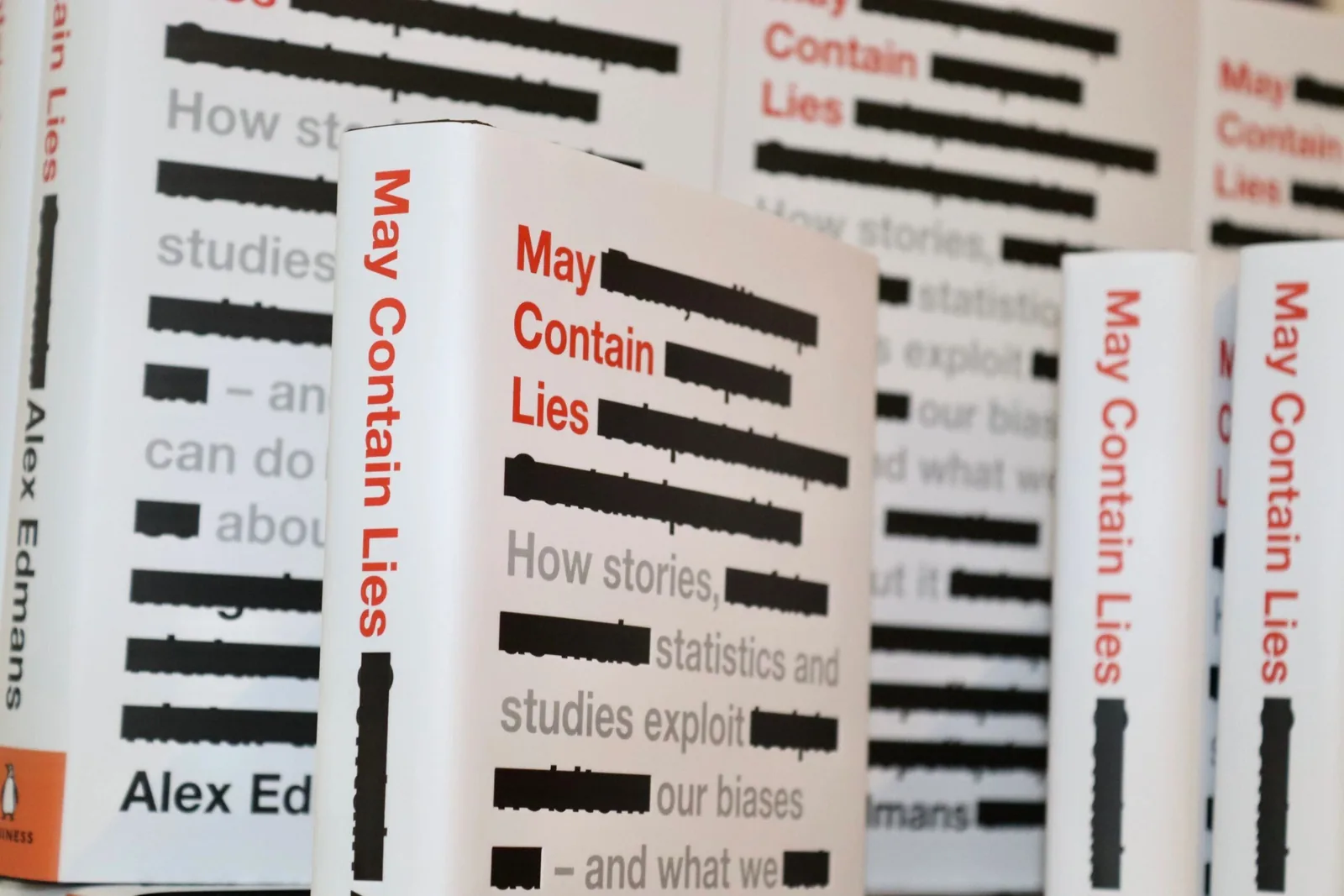
Now, Alex Edmans’ book May Contain Lies: How Stories, Statistics, and Studies Exploit Our Biases—And What We Can Do about It takes that conversation to another level. It provides a detailed roadmap for understanding how misinformation seeps into our daily lives and offers practical tools to combat it. The book's core argument is simple yet profound: our biases distort our perception of truth, making us susceptible to misinformation in ways we often don’t realize.
The Ladder of Misinterpretation
One of the most striking concepts in Edmans’ book is the “ladder of misinference.” This concept illustrates how information can become increasingly distorted as it moves through different stages of understanding. The process begins with a simple statement and progresses through facts, data, evidence, and finally to proof. At each of these steps, biases can intervene and distort the original message, causing us to arrive at conclusions that may be far removed from the objective truth.
Here’s how the ladder works:
- Statements: These are basic claims or assertions. Bias can influence how we perceive a statement based on our personal beliefs or the context in which it is presented.
- Facts: When we try to verify a statement, we often look for supporting facts. However, the selection of which facts to present—and which to omit—can introduce bias.
- Data: Facts are often aggregated into data sets. The way data is collected, categorized, or even framed can be influenced by biases, affecting how we interpret it.
- Evidence: Data becomes evidence when it is used to support a specific argument. At this stage, biases can lead us to cherry-pick data that fits our narrative while ignoring data that contradicts it.
- Proof: Finally, when we believe we have sufficient evidence, we may claim to have “proof.” However, if the underlying process was influenced by bias, this proof may be flawed.
Think about it: how often do we take a statistic at face value because it aligns with our beliefs? How frequently do we fail to question the narrative behind a study or a news article because it confirms what we already think we know? This ladder shows us that even when we think we're being rational, our biases may already be influencing our interpretation of the truth.
Social Truths vs. Objective Truths
This brings me back to Plato’s Cave, a metaphor I referenced in my earlier post. Social truths—the shadows on the cave wall—can seem so real because they’re widely accepted within our communities. But they may not reflect objective reality. Edmans’ book shows us how these social truths often stem from cleverly crafted narratives that exploit our biases.
For example, Edmans discusses the media's role in shaping public perception. Stories are presented in a way that grabs attention, but they may omit crucial context or use misleading statistics to make a point. The danger here is that these stories, repeated often enough, become accepted as truth—even when they’re not.
The Role of Bias: Why We See What We Want to See
One of the book’s most insightful contributions is its deep dive into cognitive bias. Edmans argues that we don't just absorb misinformation—we actively shape it based on what we want to believe. He explores key biases that contribute to misinference:
- Black-and-White Thinking: The tendency to oversimplify complex issues into clear-cut truths, when in reality, most topics exist in shades of gray.
- Cherry-Picking Bias: Selecting only the data that supports a preferred conclusion while disregarding the full context.
- Motivated Reasoning: Instead of evaluating information objectively, we use reasoning to justify conclusions we already favor.
- Confirmation Bias: We seek out and interpret information in ways that confirm our preexisting beliefs, ignoring contradictory evidence.
Confirmation bias is particularly dangerous. It prevents us from critically examining new information, making us more likely to accept misinformation without question.
Edmans does not just diagnose the problem—he offers solutions. He encourages readers to become more aware of their biases and provides a "Checklist for Smarter Thinking." This set of questions helps readers critically evaluate statements, assess whether data supports conclusions, and avoid being misled by persuasive but flawed arguments.
Edmans argues that understanding these biases is the first step toward guarding against them. He provides a set of tools, much like Carl Sagan’s Baloney Detection Kit, to help readers critically assess the information they encounter. These include:
- Seek Independent Confirmation: Don’t rely on a single source of information. Cross-check facts from multiple, independent sources.
- Engage in Debate: Discuss ideas with people who hold different viewpoints to test the strength of your arguments.
- Avoid Authority Worship: Just because someone is an expert doesn’t mean their statements are beyond scrutiny.
- Quantify Claims: Look for quantifiable data to support claims and avoid vague generalizations.
- Test for Falsifiability: A claim that can’t be tested or disproven isn’t a solid foundation for truth.
Why This Matters in Education
As an educator, I see the implications of Edmans’ insights in the classroom. Students today have more access to information than ever before, but that also means they’re more exposed to misinformation. Teaching students how to critically evaluate what they read and hear is crucial.
The CORE framework I developed—Concise, Organized, Relevant, and Engaging—aims to create educational experiences that respect the learner’s time and promote meaningful learning. But beyond delivering content, we must equip learners with the tools to discern truth from falsehood. Edmans’ book provides practical strategies that align perfectly with this goal.
The Search for Absolute Truth
At its heart, May Contain Lies is a call to action. It urges us to move beyond our comfort zones, challenge our preconceived notions, and seek objective truths. This pursuit isn’t easy. It requires humility and a willingness to be wrong. But it’s essential if we’re to navigate a world increasingly filled with half-truths and outright lies.
Understanding the invisible influence of our biases is the key to this process. As humans, we are all subject to biases that shape our perceptions and decisions. Recognizing this is not a weakness—it’s a strength. The Buddhist concept of a “beginner’s mind” teaches us to approach each situation with openness and a willingness to learn, free from preconceptions. This mindset allows us to challenge our assumptions and see the world more clearly.
Being willing to embrace vulnerability is another critical aspect. Accepting that we are fallible and that our beliefs may be flawed requires courage. But it’s also the first step toward growth. As F. Scott Fitzgerald once wrote, “The test of a first-rate intelligence is the ability to hold two opposing ideas in mind at the same time, and still retain the ability to function.” Similarly, Aristotle observed that “It is the mark of an educated mind to be able to entertain a thought without accepting it.” These ideas emphasize the importance of engaging with different perspectives without necessarily adopting them as our own.
This ability to critically evaluate ideas—without succumbing to bias or dogma—is perhaps the central skill required for meaningful personal change and our ability to be effective leaders. It enables us to question what we know, remain open to new information, and adjust our beliefs accordingly.
Finally, it’s essential to approach those who hold strong but unfounded beliefs with compassion and understanding. While it’s easy to dismiss or ridicule others for their misconceptions, we must remember that everyone is susceptible to bias. By fostering empathy and engaging in respectful dialogue, we can create a culture that values truth-seeking and mutual understanding over divisiveness.
Originally published on C.O.R.E Framework.