Will Vibe Coding End the Software Business? The ArtCraft Story
9 min read
About 14 min, read aloud by an AI voice.
From VisiCalc to Excel, and from Excel to a week
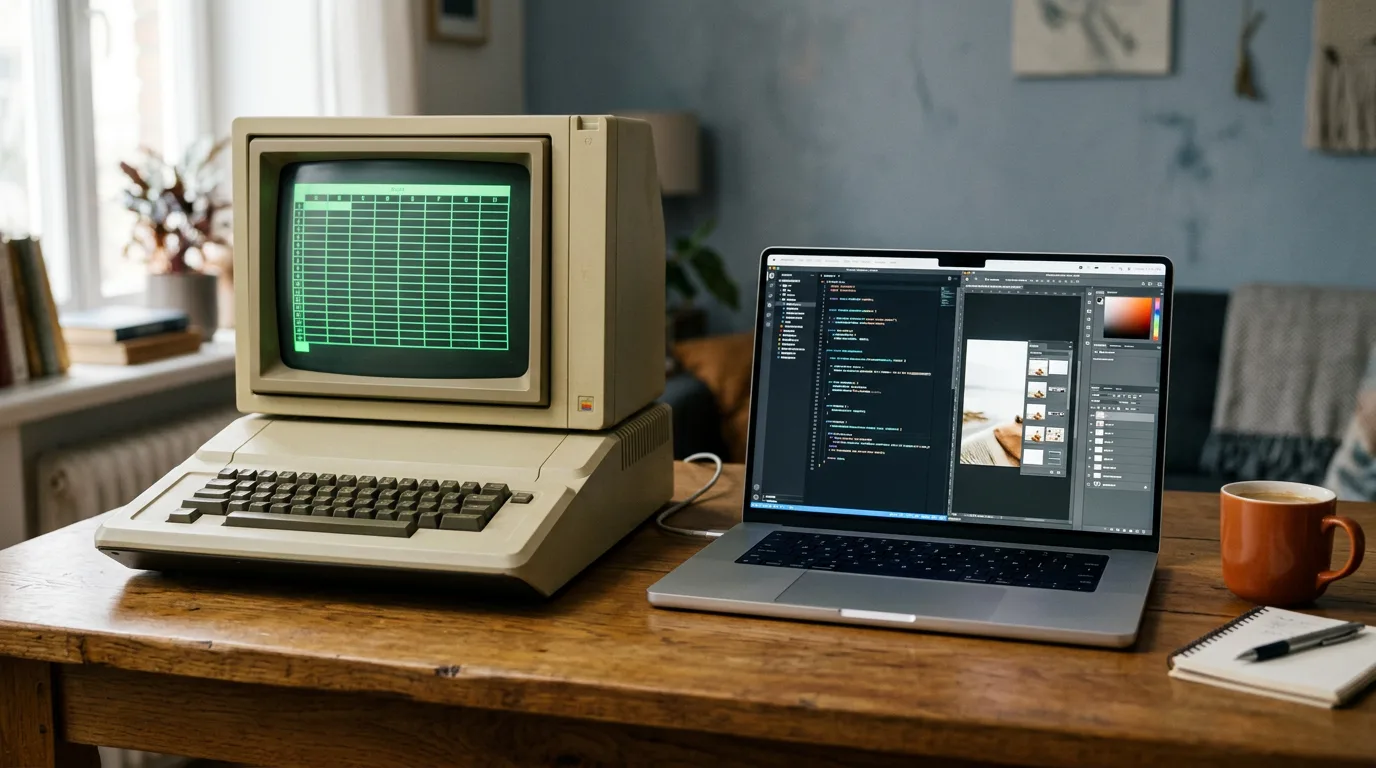
Imagine you had an idea in 1979 to build a basic spreadsheet program for the emerging desktop computer market. Dan Bricklin and Bob Frankston had exactly that idea. Their VisiCalc (opens in a new tab) shipped for the Apple II on October 17, 1979, sold for under $100, and became the reason many small businesses bought a computer at all.
Then came the retools. Lotus 1-2-3 overtook VisiCalc in 1983, and Lotus bought VisiCalc's maker in 1985 and shut the product down. Microsoft Excel arrived on the Mac in 1985 and on Windows in 1987, and over the following decades it absorbed the category. About 30 years, three or four corporate retools, armies of engineers and billions of dollars later, we have Excel as we know it.
Today one person, irritated by the SaaS subscription model, could vibe code a basic Excel from scratch in... maybe a week. That is no longer hypothetical. An open-source, Excel-style spreadsheet called GridCraft (opens in a new tab) already exists, written in Rust with AI help.
Now let's Photoshop Excel out of the picture and put Adobe in the frame.
The man Adobe charged to leave
Brandon Thomas tried to cancel his Adobe subscription and was charged a fee to walk out the door, more than once. So he rebuilt Adobe.
Thomas is an Atlanta-based engineer and filmmaker with about 15 years in software, roughly 10 of them in the Rust programming language. He is not a newcomer to AI products. He founded FakeYou, an app for AI celebrity voices, and then Storyteller, an AI film startup that has since become ArtCraft. Before that he was an engineer at Square.
The trigger was Adobe's early termination fee. Customers on the popular annual plan, paid monthly, who cancel early can be charged half of what remains on the year. The U.S. government sued Adobe over that fee in 2024, alleging it was buried in fine print and that canceling was made deliberately hard. In March 2026 Adobe agreed to a $150 million settlement ($75 million in penalties and $75 million in free services) while denying wrongdoing. The UK competition watchdog has opened its own investigation.
Thomas's answer was not a complaint letter. It was a free, open-source replacement for seven of Adobe's flagship apps.
Seven apps in about a week
The first line of PhotoCraft code was written on September 30, 2026. Eleven days later the repository had more than 44,000 GitHub stars.
| Date (2026) | What happened |
|---|---|
| Oct 11 | PhotoCraft passes 44,000 GitHub stars and roughly 6,800 forks |
| Oct 7 | WordCraft, GridCraft and DeckCraft (Word, Excel, PowerPoint) follow; coverage goes global |
| Oct 3 | Thomas announces the full Adobe-style suite on Reddit |
| Oct 2 | First PhotoCraft release |
| Sep 30 | First commit |
The engine was AI. Thomas says the apps were written in Rust with Anthropic's Claude (Claude Opus 5.5), using plain Claude Code. Rough Cut Pete counted about 7,500 code changes across the seven apps in roughly 10 days, with about 60% listing Claude as co-author.
The method matters as much as the speed. Thomas calls the apps "clean-room" reimplementations: the AI may study Adobe's programs only from the outside, by behavior, appearance and public file specifications. Each repository carries an AGENTS.md file that forbids the AI from reading, disassembling or copying the original program's code or assets, and Thomas says the team deliberately avoids decompiler tools such as Ghidra.
Two footnotes the headlines skipped. First, this is not a lone genius in a bedroom; it is a small, funded team plus dozens of volunteer contributors. Second, free is not quite free: the apps cost nothing, but ArtCraft makes money selling AI image and video credits and cloud storage on top. Thomas's own summary was blunt:
"Software is over."
The ArtCraft lineup
The suite started as seven Adobe stand-ins and has grown to 13 "Crafting Apps" that also target Microsoft Office, Figma, Pro Tools and AutoCAD. All are free, written in Rust, licensed MIT or Apache 2.0, and run on Mac, Windows and Linux, with most also running in a web browser. Every app is alpha or in development. All links below were checked live on October 30, 2026.
| App | Stands in for | What it does | Links |
|---|---|---|---|
| PhotoCraft | Adobe Photoshop | Image editing with layers, masks, PSD files | Product (opens in a new tab) · GitHub (opens in a new tab) |
| VectorCraft | Adobe Illustrator | Vector illustration | Product (opens in a new tab) · GitHub (opens in a new tab) |
| FilmCraft | Adobe Premiere Pro | Nonlinear video editing | Product (opens in a new tab) · GitHub (opens in a new tab) |
| LightCraft | Adobe Lightroom (CC, not Classic) | Photo library and raw developer | Product (opens in a new tab) · GitHub (opens in a new tab) |
| EffectCraft | Adobe After Effects | Motion graphics and compositing | Product (opens in a new tab) · GitHub (opens in a new tab) |
| DesignCraft | Adobe InDesign | Page layout and publishing | Product (opens in a new tab) · GitHub (opens in a new tab) |
| PdfCraft (first called PrintCraft) | Adobe Acrobat | PDF reader and editor | Product (opens in a new tab) · GitHub (opens in a new tab) |
| FigCraft | Figma | Interface design and prototyping | Product (opens in a new tab) · GitHub (opens in a new tab) |
| WordCraft | Microsoft Word | Word processing, native .docx | Product (opens in a new tab) · GitHub (opens in a new tab) |
| GridCraft | Microsoft Excel | Spreadsheets | Product (opens in a new tab) · GitHub (opens in a new tab) |
| DeckCraft | Microsoft PowerPoint | Slide presentations | Product (opens in a new tab) · GitHub (opens in a new tab) |
| SoundCraft | Avid Pro Tools | Audio recording and mixing | Product (opens in a new tab) · GitHub (opens in a new tab) |
| CADCraft | AutoCAD | Computer-aided design and drafting | Product (opens in a new tab) · GitHub (opens in a new tab) |
To get them:
- All Crafting Apps (opens in a new tab): the official hub for every app
- Craft Launcher (opens in a new tab): one installer that installs and updates every app
- ArtCraft AI Studio (opens in a new tab): the separate, paid AI image and video tool that funds the project (source (opens in a new tab))
- storytold on GitHub (opens in a new tab): the official organization behind all of the code
Download only from getartcraft.com or the storytold GitHub account. Look-alike download sites that bundle malware are common for popular free software.
Is it actually any good?
Impressive, but not Photoshop yet. ArtCraft's own documentation is more cautious than the headlines: on October 5 the PhotoCraft roadmap put its readiness for professional work at 25 to 35 percent.
What works: layers, masks, adjustment layers, smart objects and brushes, with native rendering and real PSD files. The project says 134 of 135 real test files save back byte for byte. One reviewer found it fast on a weak laptop.
What does not, yet: blend modes and filters that do not match Photoshop, one file that consumed 5 GB of memory, and missing marquee features such as Content-Aware Fill. One pixel artist called PhotoCraft unusable. Thomas first promised 100% parity with Adobe within a month, then walked it back to "months, not years."
The fair verdict: a remarkable alpha, not a tool to trust with a client deadline. Keep backups.
Adobe: never richer, never more nervous
On paper Adobe has never been stronger: a record $6.7 billion quarter and more than a billion monthly users. Investors disagree. The stock has fallen from about $680 a share in November 2021 to about $240, roughly 65% gone. Goldman Sachs issued a rare sell rating, new subscription business has dropped by about a third, and Shantanu Narayen, CEO for 19 years, steps down in December.
Adobe also spent years making itself easy to leave:
| Year | What happened |
|---|---|
| 2026 | $150 million settlement over cancellation fees; UK investigation opens |
| 2024 | U.S. government sues over the cancellation fee; new terms of use spark fears that customer work trains AI; reports that some Firefly training images came from Midjourney |
| 2023 | $20 billion Figma acquisition blocked; Adobe pays Figma a $1 billion breakup fee |
| 2022 | Pantone colors in customer files turn black without an extra license |
| 2019 | Users of older apps warned of possible infringement claims; Venezuelan accounts cut off under U.S. sanctions |
| 2013 | Perpetual licenses end and Creative Cloud rental begins; a breach exposes 38 million users and Photoshop source code |
Meanwhile the competition got good. Canva has more than 260 million users and made its Affinity apps free. DaVinci Resolve has had a free version for years. Adobe's own leadership now says it deferred price increases in favor of user growth, which in plain English means it cannot keep raising prices.
Can Adobe just sue? The legal picture in brief
Rebuilding what software does is generally legal; copying its code is not. That is why the words "clean room" carry so much weight in this story.
What favors ArtCraft:
- Functionality is not protected. In Lotus v. Borland (1995) a court held that a menu structure is a method of operation, not copyrightable expression. Apple lost its bid to own the look and feel of a desktop.
- Reverse engineering can be fair use. Sega v. Accolade (1992) allowed disassembly to build a compatible product, and in Google v. Oracle (2021) the Supreme Court sided with Google over copying how software talks to other software.
- The file formats are public. Adobe publishes the Photoshop file format specification, and WordCraft builds on the public ECMA-376 standard for .docx.
- The code cannot be recalled. MIT and Apache licenses cannot be revoked for copies already out there, and PhotoCraft alone was forked thousands of times in days.
Where the exposure is:
- Trade dress. Reviewers say several apps look nearly identical to Adobe's. Copying a product's distinctive look can be actionable even with zero copied code.
- Trademarks and patents. Adobe's product names have appeared in project tags, and Adobe holds thousands of patents.
- License terms. Adobe's terms of use prohibit reverse engineering; how enforceable that is, and against whom, is disputed.
- The unanswered question. A classic clean room separates two human teams. Whether an AI trained on vast amounts of public code can ever be truly "clean" has not been tested in court.
As of mid-October no lawsuit had been reported and Adobe declined to comment. One small signal worth watching: on October 30 the GitHub descriptions for the Adobe stand-ins no longer name Adobe products, while WordCraft and SoundCraft still name Microsoft Word and Avid Pro Tools. History offers mixed precedent: Nintendo shut down the Yuzu emulator with a $2.4 million settlement, but that case turned on breaking encryption to play pirated games. When the music industry got the YouTube downloader youtube-dl pulled from GitHub, it was restored within a month.
This is a general overview, not legal advice.
So, will vibe coding end the software business?
No, but it ends the software business that depends on trapping its customers. The real story is not ArtCraft; it is the recipe. If a small team and an AI can produce rough versions of seven apps in 10 days, someone else will do it next week, and the week after.
Adobe as a company will probably survive. Studios and agencies do not switch overnight; they have plugins, pipelines, training and decades of files. Rough Cut Pete sketches four ways Adobe can respond: ignore it, as it ignored GIMP and Photopea; send a lawyer's letter demanding new icons and layouts; go nuclear with patents, which would hand ArtCraft free advertising; or compete with cheaper plans, free tiers and easier cancellation. Adobe is already drifting toward the fourth, with free users up 70% last year.
The lesson reaches well beyond Adobe. Software used to be expensive to build and cheap to copy. Now building is cheap too. Features stop being a moat. What remains defensible is what an agent cannot clone in a week: data, deep integration into how people work, support, certification, liability and trust.
VisiCalc to Excel took about 30 years. GridCraft arrived about a week after ArtCraft's first commit. The spreadsheet did not get less valuable; the barrier to building one collapsed. When the competition can rebuild your product in a week and give it away, you cannot win by making it hard to leave. You have to be the one people choose anyway.
Sources
- Rough Cut Pete, "Adobe Charged Him to Cancel. So He Rebuilt Adobe." (opens in a new tab) (Oct 11, 2026)
- LegalEagle, "No More Adobe Photoshop?" (opens in a new tab) (Oct 29, 2026)
- InspirationTuts, "Free Adobe Software Killers Have Been Released!" (opens in a new tab) (Oct 10, 2026)
- innFactory AI, "Photoshop and Word Rebuilt in Rust" (opens in a new tab) (Oct 13, 2026)
- VisiCalc, Wikipedia (opens in a new tab)
- ArtCraft Crafting Apps (opens in a new tab) and storytold on GitHub (opens in a new tab)
Originally published on Russ L'HommeDieu.