Scientific Teaching (First Edition)
4 min read
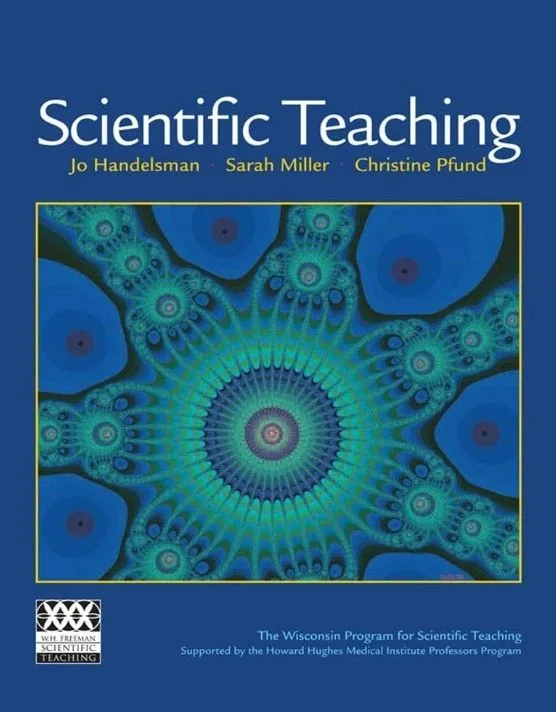
Scientific Teaching challenges educators to apply the same rigor they use in research to their teaching practice. The book translates complex findings from education, learning, and cognitive psychology into practical, actionable strategies across six focused chapters. It's not a prescription, but an invitation to approach teaching as systematically as you would approach scientific inquiry.
Author Credentials/Background
Jo Handelsman is Director of the Wisconsin Institute for Discovery, a Vilas Research Professor, and HHMI Professor. She served as science advisor to President Obama (2014-2017) and received her Ph.D. in molecular biology from University of Wisconsin-Madison. She co-founded the Wisconsin Program for Scientific Teaching, Yale Center for Scientific Teaching, and National Academies Summer Institute on Undergraduate Education. Sarah Miller and Christine Pfund (Ph.D. in Cellular and Molecular Biology) served as codirectors of the Wisconsin Program for Scientific Teaching. Pfund's research focuses on mentor-training interventions across STEMM fields and she co-authored the Entering Mentoring curriculum.
The Big Idea(s)
- Teach Like You Research: Apply the scientific method to teaching by setting learning goals, designing experiments (lessons), collecting data (assessments), and iterating based on results.
- Active Learning: Students learn best by doing, not just listening. Engagement with material through problem-solving and inquiry leads to deeper understanding.
- Assessment Drives Learning: Frequent, varied assessments provide feedback loops for both students and instructors, revealing what students actually understand.
- Diversity & Inclusion: Create inclusive learning environments that recognize diverse backgrounds, learning styles, and experiences as assets, not obstacles.
- Backward Design: Start with learning objectives, then design assessments and instruction to achieve those objectives (aligned with UbD principles).
Who Needs This Book
- Essential for: STEM faculty (especially in biology), graduate students preparing for academic careers, teaching assistants
- Highly valuable for: Department chairs developing professional development programs, instructional designers working with STEM faculty
- Useful for: Any educator interested in evidence-based teaching practices
If you're a scientist who received little to no training in how to teach, this book is your starting point.
Key Takeaways by Chapter
Chapter 1: What is Scientific Teaching?: Scientific teaching means applying experimental approaches to pedagogy. Just as you wouldn't run an experiment without controls, don't teach without learning objectives and assessment data. The chapter establishes that good teaching is testable, reproducible, and evidence-based.
Chapter 2: Active Learning: Lecture alone doesn't work for deep learning. Students need to wrestle with concepts through think-pair-share, problem-based learning, case studies, and hands-on activities. Provides specific techniques with implementation guidance.
Chapter 3: Assessment: Move beyond end-of-term exams. Use formative assessments (concept inventories, minute papers, clicker questions) to gauge understanding in real-time and adjust teaching accordingly. Assessment should inform instruction, not just assign grades.
Chapter 4: Diversity: Inclusive teaching isn't just ethically right, it's pedagogically effective. Address stereotype threat, create belonging, use diverse examples and perspectives, and recognize that "deficit thinking" harms student success. Practical strategies for creating inclusive classrooms.
Chapter 5: Backward Design: Start with learning goals, determine how you'll measure achievement, then design instruction. This chapter provides templates and examples for aligning objectives, assessments, and activities (strongly echoes Wiggins & McTighe).
Chapter 6: Teaching Teachers: How to train others in scientific teaching approaches. Essential for department chairs, workshop facilitators, or anyone leading faculty development. Includes workshop designs and materials.
Questions It Provokes
- Am I applying the same standards of rigor to my teaching that I apply to my research?
- How do I know if my students are actually learning what I think I'm teaching?
- What percentage of my class time involves students actively engaging vs. passively receiving?
- How do my classroom practices either support or undermine students from underrepresented groups?
- If teaching is my "experiment," what data am I collecting and how am I using it?
- Can I articulate specific, measurable learning objectives for every class session?
Recommendation Strength
ESSENTIAL for anyone teaching undergraduate science, especially biology. At 184 pages with concrete examples, this is the most accessible entry point into evidence-based STEM teaching.
Highly Recommended for graduate students and postdocs. Read this before you start teaching, not after five years of ineffective lectures.
The book's strength is its brevity and practicality. Unlike dense education theory texts, this gives scientists the "why" backed by research and the "how" with immediately usable strategies. The recommendations were tested through the National Academies Summer Institute on Undergraduate Education in Biology and the Wisconsin Program for Scientific Teaching, so these aren't just theories.
Related Resources
- Understanding by Design (Wiggins & McTighe): The theoretical foundation for backward design that Scientific Teaching builds upon
- How Learning Works: Seven Research-Based Principles (Ambrose et al.): Deeper dive into cognitive science behind learning
- Teaching at Its Best (Nilson): Comprehensive practical guide across all disciplines
- National Academies "How People Learn": Research foundation on learning science
- CIRTL Network: Community of practice for scientific teaching in STEM
- Your CORES Framework: Complementary emphasis on evidence-based instructional design
Comparison: While UbD provides the curriculum design framework, Scientific Teaching focuses specifically on STEM pedagogy and classroom implementation. They're highly complementary. Use UbD for unit/course design, use Scientific Teaching for day-to-day teaching strategies. Scientific Teaching is shorter, more practical, and STEM-specific, making it more immediately actionable for science faculty.
Originally published on C.O.R.E Framework.