The Architecture of Human Trust
4 min read
Trust is considered the cornerstone of cohesive societies, resilient organizations, and meaningful relationships. Although frequently discussed, the underlying architecture of trust remains intricate; an interplay of psychological, social, and neurobiological factors that determines who we rely upon, when, and why.
Contemporary research from behavioral science, economics, and neuroscience broadens our understanding, highlighting not just how trust is fostered, but also the ways it can be subverted or defended.
Foundations and Components of Trust
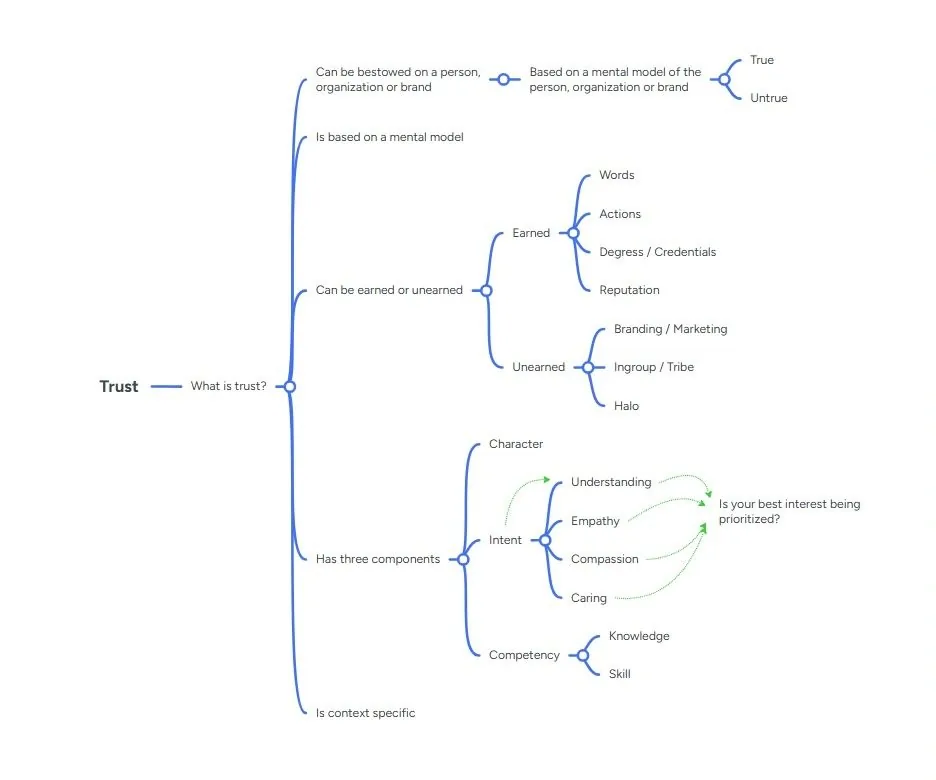
Trust is fundamentally a mental model. It is a belief system about the reliability, intent, and competence of another party. It can be granted to individuals, organizations, or brands based on either evidence (earned trust) or superficial impressions (unearned trust). Trust is shaped by the trustor's baseline disposition, shaped by genetics, culture, and past experiences (Rotter, 1980; Yamagishi & Yamagishi, 1994).
Building on established frameworks (e.g., Mayer, Davis, & Schoorman, 1995), trust comprises three principal axes:
- Character: Incorporating integrity, honesty, and predictability—does this entity act consistently and morally?
- Intent: Is the other party acting in your genuine interest? This encompasses empathy, compassion, and benevolence.
- Competency: Does the person or organization possess the necessary knowledge or skills to warrant confidence?
Context heavily influences which dimensions predominate. For high-stakes business, competency and integrity may lead. In personal relationships, intent and empathy often matter most (Lewicki, McAllister, & Bies, 1998).
The Neuroscience of Trust
Neuroscientific studies identify specific brain circuits involved in trust decisions. The prefrontal cortex evaluates risk and processes social information; the hormone oxytocin increases prosocial behaviors and group trust, but can blunt skepticism (Kosfeld et al., 2005). This biochemical foundation enables trust to be “rewarding,” especially within groups, but also creates neural shortcuts that manipulators may exploit (Zak & Knack, 2001).
Trust as a Dynamic Process
Trust is not static: it evolves through repeated interactions, feedback, and relational experience. Positive experiences and reciprocity reinforce trust; betrayals or inconsistencies lead to recalibration and, sometimes, excessive caution (Baier, 1986). Individual differences, such as a person's dispositional trust, change how quickly and readily they extend trust to others.
Mechanics of Manipulation
Understanding trust also means understanding its vulnerabilities:
- False Signals: Phony credentials, social proof, or bandwagon effects manufacture "credibility" (Cialdini, 2007).
- Cognitive Bias Exploitation: Manipulators exploit heuristics such as confirmation bias or urgency cues (Kahneman & Tversky, 1979).
- Fake Transparency: Oversharing details can feign openness, lowering a person's guard.
- Tribalism & Group Identity: Cues of shared identity, values, or goals evoke trust by default.
- Isolation and Pressure: Limiting external input and demanding quick decisions increase vulnerability.
Building and Defending Trust
A robust, modern framework for trust-building and manipulation resistance incorporates:
- Transparency and Consistency: Clear communication and predictable behaviors foster safety.
- Critical Verification: Encourage seeking evidence, double-checking credentials, and consulting trusted third parties.
- Emotional Awareness & Boundaries: Understanding personal triggers, regulating emotions, and knowing when to say "no" to guard against psychological manipulation (Gross & John, 2003).
- Feedback Loops: Trust strengthens through reciprocation and reflection. External validation, via support networks, protects against distortions of judgment.
- Contextual and Cultural Awareness: Recognizing that trust signals and manipulation tactics differ across contexts and cultures ensures more adaptive responses.
Visualizing the Trust Framework
The attached mind map synthesizes these multi-level influences, from context and components to the dangers of unearned trust and manipulation. It underscores that trust is highly context-specific, dynamic, and reciprocal.
Conclusion
Trust is at once a leap of faith and a calculated risk. Most importantly, it is built through a combination of character, intent, and competence tempered by the awareness that our cognitive shortcuts can be both our greatest allies and our most significant liabilities. By embracing transparency, verification, emotional intelligence, and a nuanced appreciation for context, individuals can foster more trustworthy lives and shield themselves from those who would exploit the very architecture of trust.
References
- Baier, A. (1986). Trust and antitrust. Ethics, 96(2), 231-260.
- Cialdini, R. B. (2007). Influence: The psychology of persuasion (Rev. ed.). New York: Harper Business.
- Gross, J. J., & John, O. P. (2003). Individual differences in two emotion regulation processes: Implications for affect, relationships, and well-being. Journal of Personality and Social Psychology, 85(2), 348-362.
- Kahneman, D., & Tversky, A. (1979). Prospect theory: An analysis of decision under risk. Econometrica, 47(2), 263-291.
- Kosfeld, M., Heinrichs, M., Zak, P. J., Fischbacher, U., & Fehr, E. (2005). Oxytocin increases trust in humans. Nature, 435, 673–676.
- Lewicki, R. J., McAllister, D. J., & Bies, R. J. (1998). Trust and distrust: New relationships and realities. Academy of Management Review, 23(3), 438-458.
- Mayer, R. C., Davis, J. H., & Schoorman, F. D. (1995). An integrative model of organizational trust. Academy of Management Review, 20(3), 709-734.
- Rotter, J. B. (1980). Interpersonal trust, trustworthiness, and gullibility. American Psychologist, 35(1), 1–7.
- Yamagishi, T., & Yamagishi, M. (1994). Trust and commitment in the United States and Japan. Motivation and Emotion, 18(2), 129-166.
- Zak, P. J., & Knack, S. (2001). Trust and growth. Economic Journal, 111, 295–321.
Originally published on C.O.R.E Framework.