Mastering Priorities: The Eisenhower Matrix
8 min read
If you read this blog, you can probably figure out that I love a good matrix. In the blog post "Creating a Culture of Trust and Safety with Students," I discuss the "Is It Safe? Is It Worth It?" matrix from Stephen Shedletzky's work, which helps determine when people feel empowered to speak up. In the post "How the Navy SEALs Can Help You Build an Awesome Faculty," I talk about the Trust-Performance Matrix that elite teams use to evaluate members based on both their performance and their trustworthiness. And in "Manage your Energy NOT your Time," I share a 2x2 matrix for plotting activities based on energy drain versus importance. In "The Mentor Mindset" I describe a matrix where one axis represents expectations, the other represents support.
I think the reason I like this visualization/conceptualization so much is that matrices act like navigational aids. Literal maps that guide us to a way of looking at the world that helps us move more efficiently toward our goals. They take complex, multidimensional problems and create clarity through simple visual frameworks.
Today, I want to share another powerful matrix that has stood the test of time: the Eisenhower Matrix.
The Origin Story: From Battlefield to Boardroom
In 1954, Dwight D. Eisenhower visited Northwestern University and delivered an address to the Second Assembly of the World Council of Churches. There, he shared wisdom that would inspire one of the most enduring productivity frameworks: "I have two kinds of problems, the urgent and the important. The urgent are not important, and the important are never urgent" (as cited in Quote Investigator, 2014). Interestingly, Eisenhower attributed these words to an unnamed "former college president" rather than claiming credit himself (Eisenhower, 1954).
This wasn't theoretical for Eisenhower. As a military leader, he had to prioritize urgent crises (like battlefield decisions) while keeping sight of important long-term strategies (like planning the D-Day invasion). Later, as president, he balanced immediate challenges ( The Cold War comes to mind) with visionary projects, such as the creation of NASA and the Interstate Highway System (Taskford, n.d.).
Decades later, author Stephen Covey popularized Eisenhower's framework in his book The 7 Habits of Highly Effective People, transforming it into the practical tool we know today (Asana, 2025; ProductPlan, 2025).
Understanding the Matrix: Four Quadrants That Change Everything
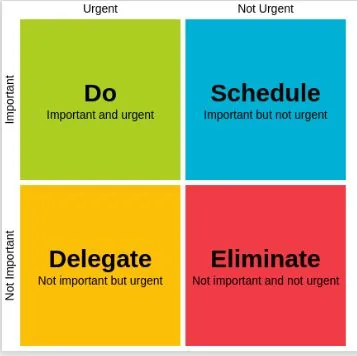
Like the other matrices I've discussed, the Eisenhower Matrix uses a 2x2 grid to create four distinct quadrants. But instead of measuring trust vs. performance or energy drain vs. importance, this one maps urgency against importance.
The Critical Distinction
Before we dive into the quadrants, let's clarify these often-confused terms:
- Urgent tasks demand immediate attention and carry clear consequences for not satisfying or completing them on time (TechtTarget, n.d.). They trigger our stress response and put us in reactive mode.
- Important tasks contribute to your long-term mission, values, and goals. They may not yield immediate results (making them easy to neglect) (Slab, n.d.). These tasks require a responsive, strategic mindset.
The Four Quadrants Explained
Quadrant 1: Do First (Urgent & Important) These tasks need to be done today or tomorrow at the latest (Eisenhower.me, 2017). Think crisis management, pressing deadlines, or emergency situations. While necessary, living primarily in this quadrant leads to stress and burnout.
Quadrant 1 is simultaneously unavoidable and unsustainable. Some genuine emergencies will always arise: a patient falls, a critical deadline appears, equipment fails, or a family crisis occurs. These are the unpredictable realities of life that demand immediate attention. However, there's a crucial distinction between inevitable emergencies and manufactured crises.
Here's the insidious truth about Quadrant 1: the more time we spend there, the more time we're forced to spend there. As Covey (1989) observed, when we're constantly in crisis mode, we have no time or energy for the preventive, planning, and relationship-building activities of Quadrant 2. This creates what researchers call a "urgency trap" (Zhu, Yang, & Hsee, 2018). We become addicted to the adrenaline of urgency while simultaneously depleting our capacity to think strategically.
Living in Quadrant 1 is like constantly bailing water from a leaking boat without ever stopping to patch the holes. Each day brings new leaks because we never invested time in maintenance. As one emergency flows into the next, we lose the ability to distinguish between what's genuinely urgent and what has simply become urgent through neglect.
Many Quadrant 1 "emergencies" are actually Quadrant 2 activities that we ignored until they became crises.
**Quadrant 2: Schedule (Important but Not Urgent)**This is what I call the "Quadrant of Quality." These tasks are directly aligned with your long-term goals, values, and happiness (Slab, n.d.). Professional time managers leave fewer things unplanned and therefore try to manage most of their work in the second quadrant (Highberg, n.d.).
Quadrant 3: Delegate (Urgent but Not Important) These are tasks you could delegate as they are less important to you than others but still pretty urgent (Eisenhower.me, 2017). They often involve other people's priorities masquerading as your own.
Quadrant 4: Delete (Neither Urgent nor Important) These tasks are okay if you have time or need a break from the more important and more urgent items, but they should not displace them on your list of priorities (ProductPlan, 2025).
The Science Behind Why It Works
A recent study in the Journal of Consumer Research examined how people decide what to work on when faced with tasks of mixed urgency and importance. Across five separate experiments, researchers observed that our attention is drawn to time-sensitive tasks over tasks that are less urgent, even when the less urgent task offers greater rewards (as cited in Todoist, 2021). This psychological quirk, dubbed the "Mere Urgency Effect", explains why we're so bad at time management.
The good news? This mere-urgency effect can be reversed. When participants were prompted to consider the consequences of their choices at the time of selection, they were significantly more likely to choose the important task over the urgent one (Todoist, 2021).
Implementing the Matrix: A Practical Guide
Step 1: Track Your Current Reality
Track your time for one week to assess where you spend your time in the matrix. You can use a dedicated task management tool or simply track your time in 30-minute increments in a spreadsheet (Slab, n.d.).
Step 2: Categorize Your Tasks
List all your tasks and honestly assess:
- Does this have a deadline? (Urgency)
- Does this align with my core goals? (Importance)
Step 3: Apply the Appropriate Strategy
Remember the four D's:
- Do: Complete Q1 tasks immediately
- Decide: Schedule Q2 tasks for specific times
- Delegate: Find others to handle Q3 tasks
- Delete: Eliminate or minimize Q4 activities
Step 4: Rebalance Your Matrix
To reduce the number of Quadrant 1 tasks you have, invest time in planning to anticipate and prevent problems (Slab, n.d.). The goal is to spend more time in Quadrant 2, where real progress happens.
Common Pitfalls and How to Avoid Them
The Urgency Trap
Many people spend a significant amount of their time managing crisis situations and putting out fires all day. They react to others' priorities and miss out on the real important tasks (Highberg, n.d.). Combat this by starting each day with a Quadrant 2 activity before checking email or messages.
Difficulty Delegating
If you struggle to delegate (Quadrant 3), remember that delegation isn't abdication—it's strategic resource allocation. Start small with low-risk tasks and build trust gradually.
The Perfectionist's Dilemma
Limiting your task list to necessary action items will ensure you're beginning the prioritization process with no time to waste (Asana, 2025). Keep no more than 10 items per quadrant to maintain clarity.
Making It Stick: Integration Strategies
Digital Implementation
In Todoist, you can use labels and filters to help organize and sort your task list according to the matrix (Todoist, 2021). Modern task management tools have built-in features for categorizing tasks by urgency and importance.
Separate Personal and Professional
Create separate matrices for your personal and professional to-do lists. Your work and personal tasks require different timelines, resources, and methods (Asana, 2025).
The Matrix as a Navigation Tool
Just like the Trust-Performance Matrix helps us build better teams, and the Energy-Importance Matrix helps us manage our vitality, the Eisenhower Matrix helps us navigate the constant stream of demands on our attention. It's not about doing more—it's about doing what matters.
"The key is not to prioritize what's on your schedule, but to schedule your priorities" (Covey, 1989, as cited in Slab, n.d.).
When you consistently invest time in important but not urgent activities, you're playing the long game. You're building relationships before you need them, developing skills before they're required, and solving problems before they become crises.
Your Next Step
The matrix's power lies not in its complexity but in its clarity. Like all good navigation tools, it doesn't tell you where to go—it helps you see where you are and make better decisions about your direction.
Start simple:
- Draw a four-quadrant grid
- List tomorrow's tasks
- Place each in the appropriate quadrant
- Follow the Do, Decide, Delegate, Delete framework
The Eisenhower Matrix isn't just about getting more done; it's about getting the right things done (Taskford, n.d.). In a world that profits from your distraction, the ability to distinguish between what's truly important and what's merely urgent isn't just a productivity hack—it's a superpower.
References
Asana. (2025, January 29). The Eisenhower Matrix: How to prioritize your to-do list [2025]. https://asana.com/resources/eisenhower-matrix (opens in a new tab)
Covey, S. R. (1989). The 7 habits of highly effective people. Free Press.
Eisenhower, D. D. (1954, August 19). Address at the Second Assembly of the World Council of Churches. The American Presidency Project. https://www.presidency.ucsb.edu/documents/address-the-second-assembly-the-world-council-churches-evanston-illinois (opens in a new tab)
Eisenhower.me. (2017, February 7). The Eisenhower Matrix: Introduction & 3-minute video tutorial. https://www.eisenhower.me/eisenhower-matrix/ (opens in a new tab)
Highberg. (n.d.). Eisenhower Matrix for time management. https://highberg.com/insights/eisenhower-matrix-for-time-management (opens in a new tab)
Perfony. (2022, February 25). History of the Eisenhower Matrix. https://www.perfony.com/en/history-of-the-eisenhower-matrix/ (opens in a new tab)
ProductPlan. (2025, July 8). Eisenhower Matrix | Prioritization framework | Definition and examples. https://www.productplan.com/glossary/eisenhower-matrix/ (opens in a new tab)
Quote Investigator. (2014, May 9). Quote origin: What is important is seldom urgent and what is urgent is seldom important. https://quoteinvestigator.com/2014/05/09/urgent/ (opens in a new tab)
Shedletzky, S. (2023). Speak-up culture: When leaders truly listen, people step up. Page Two Books.
Sinek, S. (2024). A Navy SEAL's guide to high performance at work. https://simonsinek.com/product/a-navy-seals-guide-to-high-performance-at-work/ (opens in a new tab)
Slab. (n.d.). The Eisenhower Matrix: Prioritize your time on what matters most. https://slab.com/blog/eisenhower-matrix/ (opens in a new tab)
Taskford. (n.d.). Eisenhower Matrix explained: A simple way to prioritize your works. https://taskford.com/en/blog/eisenhower-matrix (opens in a new tab)
TechtTarget. (n.d.). What is the Eisenhower Matrix? https://www.techtarget.com/whatis/definition/Eisenhower-Matrix (opens in a new tab)
Todoist. (2021, January 13). Avoid the "urgency trap" with the Eisenhower Matrix. https://www.todoist.com/productivity-methods/eisenhower-matrix (opens in a new tab)
Originally published on C.O.R.E Framework.