Making PROGRESS: A Framework for Sustainable Achievement
6 min read
Setting goals is one thing. Actually achieving them is another. After years of teaching, coaching, and personal transformation (including my own 200-pound weight loss journey), I've learned that the difference between good intentions and real results often comes down to having the right framework for planning. That's where the PROGRESS framework comes in. It's a systematic approach to creating plans that actually work.
The Power of Written Commitment
Research consistently shows that writing down your goals dramatically increases your likelihood of achieving them. When you write a plan, you transform a vague intention into a concrete commitment. It becomes a contract with yourself. A contract that deserves the same respect as any promise you'd make to someone else.
The beauty of effective planning is that it doesn't need to be complicated. Simple, well-structured plans that ensure small wins will always outperform elaborate schemes that never get executed. Each small success builds confidence and reveals capabilities you might not have known you possessed.
Understanding the PROGRESS Framework
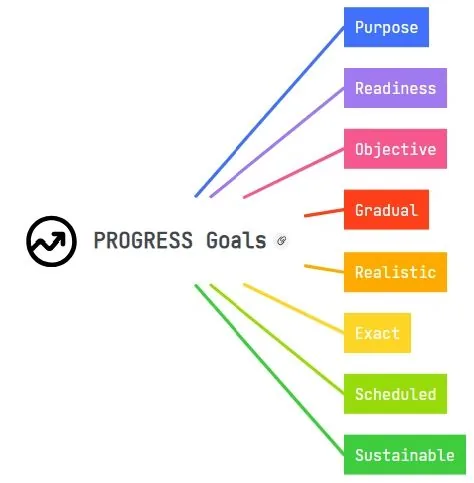
Every effective plan should pass the PROGRESS test. This framework ensures your goals are not just wishful thinking but actionable blueprints for change. Let me break down each element:
P is for Purpose
Purpose is your "why"? What is the deep reason that will sustain you when motivation wanes? Without a clear purpose, even the best-laid plans crumble at the first obstacle. Before setting any goal, ask yourself: "Why does this matter to me?" The stronger your purpose, the straighter your path to success. Purpose serves as your compass, keeping you oriented even when you can't see far ahead.
R is for Readiness
Many perfectly good plans die on the vine because you're just not ready for them. Rate your readiness on a scale of 1-10. If you're below an 8, modify the goal. It's not about lowering standards. It's about finding the right starting point. A smaller goal you'll actually pursue beats an ambitious one that remains theoretical.
O is for Objective
Objective goals are measurable and specific. They're based on facts, not wishful thinking. Instead of "exercise more," write "walk for 20 minutes on Monday, Wednesday, and Friday." You'll know exactly when you've succeeded. Pro tip: Use "at least" language to allow for overachievement: "I will walk for at least 20 minutes, at least three days this week."
G is for Gradual
Big problems are just collections of small problems. Sustainable change happens incrementally. Ask yourself: "What's the smallest step I can take right now that will yield the biggest result?" This question transforms overwhelming challenges into manageable actions. Research confirms that gradual progress leads to more lasting change than dramatic leaps.
R is for Realistic
Visualize yourself executing your plan. Rate your confidence level from 1-10. Below 8? Adjust the plan. Consider practical questions: Do I have the necessary resources? When exactly will I do this? Am I physically capable? Realistic planning isn't about limiting yourself—it's about setting yourself up to win.
E is for Exact
Precision eliminates wiggle room. Start plans with "I WILL" rather than "I'll try." Specify exact days, times, and conditions. Instead of "exercise this week," write "I will walk in the park every Tuesday and Thursday at 6:30 AM after breakfast." Exactness transforms vague intentions into concrete actions.
S is for Scheduled
Deadlines create urgency and combat procrastination. As MIT behavioral economist Dan Ariely's research shows, even self-imposed deadlines significantly improve both completion rates and quality of work. Put your goals on your calendar. Treat them as non-negotiable appointments with yourself.
S is for Sustainable
The ultimate test: Can you maintain this long-term? Unsustainable plans are, by definition, temporary. As you write your plans, envision them becoming lifelong habits. When new behaviors align with how you see yourself, they require minimal effort to maintain.
The PROGRESS Commitment Contract
To help you implement this framework, I've developed the PROGRESS Commitment Contract. This tool systematically guides you through creating commitments that work:
1. Writing your commitment clearly and specifically
Transform vague intentions into concrete actions. Compare these two statements:
- Vague: "I'm going to try to get healthier."
- Clear: "I WILL walk briskly with my colleague for at least 15 minutes during lunch on Monday, Wednesday, and Friday this week."
The second version tells you exactly what, when, where, with whom, and for how long. There's no room for confusion or excuses.
2. Rating your readiness and confidence (both should be 8 or higher)
Ask yourself two critical questions:
- "On a scale of 1-10, how READY am I to do this?"
- "On a scale of 1-10, how CONFIDENT am I that I will complete this?"
If either number falls below 8, don't abandon the goal—adjust it. Maybe "every day" becomes "three days." Maybe "30 minutes" becomes "10 minutes." Find the version that gets you to 8+.
3. Identifying barriers and planning solutions
Before you start, anticipate what might stop you. Common barriers include:
- Time constraints → Solution: Schedule it like an appointment
- Weather issues → Solution: Have an indoor backup plan
- Lack of motivation → Solution: Find an accountability partner
Write these down. When barriers arise (and they will), you'll already have your solutions ready.
4. Tracking completion for accountability
The contract includes a simple weekly grid, check off each day you complete your commitment. This visual tracking serves two purposes:
- It provides immediate satisfaction when you check a box
- It creates a visual chain you won't want to break
Even partial completion becomes visible progress rather than invisible failure.
5. Documenting wins and learning from attempts
After each week, record two things:
- What you accomplished (even if it wasn't 100%). List at least three specific achievements
- What you learned. Identify at least three insights about yourself, your process, or your barriers
This reflection transforms every attempt into valuable data for your next commitment.
6. Building on success with your next commitment
Each contract ends with a forward-looking question: "Based on what you accomplished or learned, how will you adjust your next commitment?" This creates an iterative cycle where each week builds on the last, whether through:
- Increasing intensity (10 minutes becomes 15)
- Adding frequency (2 days becomes 3)
- Trying a different approach based on what you learned
Key Features of the Contract:
- The 8+ Rule: If either your readiness or confidence is below 8, rethink and rewrite your commitment
- Barrier Planning: Proactively identify obstacles and solutions
- Weekly Tracking: Check off completed days to build momentum
- Growth Mindset: Whether you achieve 100% or not, you document what you accomplished and learned
- Iterative Improvement: Each contract builds on the previous one's lessons
The Learning Principle
Whether you achieve 100% of your commitment or partial success, the real value lies in what you learn. Complete success teaches you what works. Partial success reveals important information about barriers, timing, or scope. This isn't about harsh self-judgment or forced celebration—it's about gathering data to make your next commitment more effective. Every attempt, regardless of outcome, moves you closer to understanding what sustainable progress looks like for you.
Your Next Step
Remember: You cannot fail if you remain willing to adjust your approach. A plan that doesn't work isn't a reflection on you—it's simply data telling you to try a different strategy.
Start today:
- Download the PROGRESS Commitment Contract
- Pick one goal that matters to you
- Run it through all eight PROGRESS criteria
- Rate your readiness and confidence
- Sign your contract
- Take the first step
Success isn't about perfection—it's about PROGRESS.
Ready to make your first PROGRESS commitment? Download the worksheet and start with something small but meaningful. (opens in a new tab) Remember, the smallest step forward is still forward motion.
Originally published on C.O.R.E Framework.